By Elena Bou, Co-Founder and Executive Board Member of InnoEnergy, and Francisco Velázquez de Cuéllar, Founder and Managing Partner of Axon Partners Group
Executive summary:
- Europe’s scale-up challenge is real — and it cannot be solved by capital alone. Growth capital is essential, but scale is achieved only when capital is deployed within strong ecosystems.
- Europe leads in clean tech innovation, yet many companies struggle to translate early leadership into
industrial scale. - Pan-European, public–private ecosystems already exist to de-risk scale-up execution and improve returns.
- The winning model for Europe is clear: capital and ecosystems working together.
- The priority now is to scale what already works.
Recent strategic discussions on Europe’s technology and industrial future have rightly raised the urgency of building globally competitive scale-ups. In their recent OpEd “Attention Is Just the Start: Seizing Europe’s Strategic Tech Opportunity”,1 EQT makes a compelling and timely case: Europe has world-class talent, strong research foundations, and a narrow window to turn innovation into global leadership.
We concur with much of this diagnosis. The challenge is real, the stakes are high, and the opportunity is still within reach. Yet the real constraint on European scale-ups is not only capital2, but the systemic execution required to turn innovation into industrial scale.
The success of a scale-up, regardless of sector — whether clean tech, health, digital or otherwise — depends on a precise combination of conditions. These include a solid order book; a controlled and diversified supply chain; mastery of the underlying technology; the ability to manufacture at scale; “fit for purpose” governance; a stable and predictable regulatory environment; an outstanding management team; access to a sufficiently trained workforce; short and reliable permitting timelines; abundant and affordable energy supply; and strong, trust-based relationships with other ecosystem actors. In many cases, this also includes targeted public support or protection during the ramp-up phase, alongside private — and sometimes public — capital. Crucially, all of these conditions must be met simultaneously, in an increasingly competitive global environment where Europe is not always the first mover.
The good news is that, over the past 15 years, Europe has deliberately developed thematic, specialised ecosystems, supported by a clear public vision and sustained public–private engagement. These ecosystems — known as Knowledge and Innovation Communities (KICs) — bring together and actively coordinate private and public actors across the full set of conditions required for scale, systematically de-risking each dimension. Combined with sufficient growth capital, these structures — unique in the world — enable Europe to build global champions capable of competing and winning internationally.
Scale is built by ecosystems, not capital alone
The gap between Europe and the United States in producing global technology champions is well documented. However, framing this gap primarily as a shortage of growth capital risks oversimplifying a far more complex reality.
While Europe remains weaker in certain areas of digital innovation, it is a recognised leader in clean tech innovation, producing more clean tech startups than the US.3 Yet progress across Europe’s innovation ecosystem remains uneven: in areas such as AI faster acceleration is still required, and in clean tech many companies struggle to translate early leadership into industrial scale. Across both, evidence increasingly shows that capital availability alone is not the dominant bottleneck.
Recent analysis from the World Economic Forum on scaling hard-to-abate sectors rightly highlights that the most persistent barriers to industrial scale are execution related: securing early demand, integrating into industrial value chains, navigating permitting, and aligning financing with long development timelines.4 The European Commission’s Innovation Fund Knowledge Sharing Report (2025) echoes this, identifying permitting delays, supply chain constraints and the difficulty of securing long-term offtake contracts as recurring scale-up pain points.5
Scaling tech requires more than funding rounds. It requires:
- Offtakers to anchor early demand
- Industrial partners and suppliers to integrate into existing value chains
- Regulatory pathways that enable deployment
- Project finance and blended capital to bridge first-of-a-kind
- Skills and workforce pipelines to sustain growth
- “Fit for purpose” governance along the journey
Growth capital accelerates scale – but the above features are fundamental to de-risk and enhance each investment case. Returns are a must, yet returns need to be secured by de-risking these dimensions, with the knowledge intrinsic to each vertical.
This is precisely where ecosystem-based models create a structural advantage. By aligning corporates, startups, public actors and financiers around shared industrial outcomes, ecosystems reduce risk across multiple dimensions simultaneously; and improve the base cases.
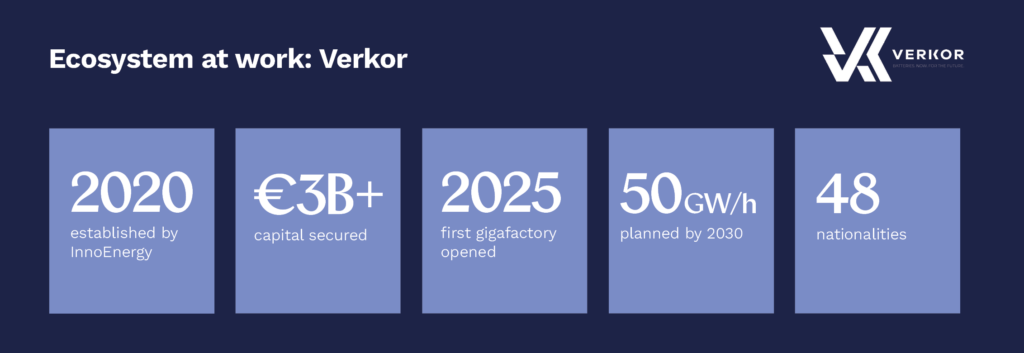
This is not theoretical. Across Europe, scale ups such as Verkor, Skeleton and GravitHy are not scaling in isolation. They are scaling through one structured platform: the InnoEnergy ecosystem – a single, pan-European public-private ecosystem deliberately implemented over the last 15 years to build globally competitive European champions.
Europe is a market shaped by regulation – scaling European champions makes ecosystems essential
Europe is not the United States — and this is not a disadvantage to be corrected, but a strength to be leveraged. The European Single Market provides scale through integration: a unified economic space of nearly 450 million consumers, shaped by a shared regulatory framework and common strategic priorities.
In Europe, innovation typically starts local, scales at the European level, and ultimately competes globally. For scale-ups, the size and predictability of the addressable market are decisive. Europe’s regulatory framework, therefore, plays a central role in shaping markets, particularly in strategic technology areas linked to climate, energy security and industrial sovereignty.
Recent policy frameworks such as the Net-Zero Industry Act, the Clean Industrial Deal and the upcoming Industrial Acceleration Act reflect this logic. By aligning regulation, public procurement and targeted state aid around shared objectives, Europe is creating clearer pathways from innovation to scale and helping anchor future champions in Europe.
The practical challenge lies in translating this integrated market into execution at scale. Moving from local success to European leadership requires coordination across borders, actors and value chains. In this context, pan-European ecosystems are not optional infrastructure — they are the mechanism through which scale is delivered.
By aligning innovation, industry and policy within a single operating framework, they enable European scale-ups to convert market opportunity into sustained industrial scale and long-term competitiveness.
The European way vs the American way
Returns matter. It’s a must, and any business must ultimately meet investor expectations.
But European scale-ups are also expected to deliver more: jobs, industrial resilience, supply chain security and strategic autonomy. This dual mandate increases complexity – but it also increases durability and resilience.
European scale-ups must deliver returns and a soul. This is not a weakness; it is why they endure.
In sectors such as batteries, energy systems, industrial decarbonisation and advanced materials, European companies are scaling precisely because they are embedded in real economies – employing local workforces, anchoring value chains, and aligning with long-term societal goals.
This model contrasts with the American approach, which often prioritises speed and market dominance first, with systemic considerations addressed later. Europe’s approach is slower – but it produces assets that are harder to displace and more resilient over time.
Europe’s head start – and why we can’t start again
Europe has already invested with intent over the past 15 years in building the foundations of its tech ecosystems — most visibly through long-term, public–private platforms such as InnoEnergy. Through InnoEnergy’s pan-European ecosystem, thematic Knowledge and Innovation Community (KIC) structures, and structured pipeline development, a single operational system has been built that is enabling scale today.
This system is already delivering concrete results. It is producing scale-ups and scale-ready companies, and orchestrating portfolios across entire value chains — from innovation and industrial validation to first commercial deployment.
Growth capital is now arriving to build on this groundwork. And it is essential. Europe needs capital at scale to support its next generation of global champions. But capital delivers its full potential only when it is deployed into an environment that systematically reduces risk and accelerates execution. In this context, ecosystems are not an alternative to investment — they are the de-risking factor.
By aligning industrial partners, offtakers, supply chains, talent, public actors and policy frameworks, the InnoEnergy ecosystem reduces execution risk, shortens time to market, and improves the risk–return profile of each investment case. This is what makes returns more predictable, more resilient and ultimately more attractive — particularly in capital-intensive tech sectors.
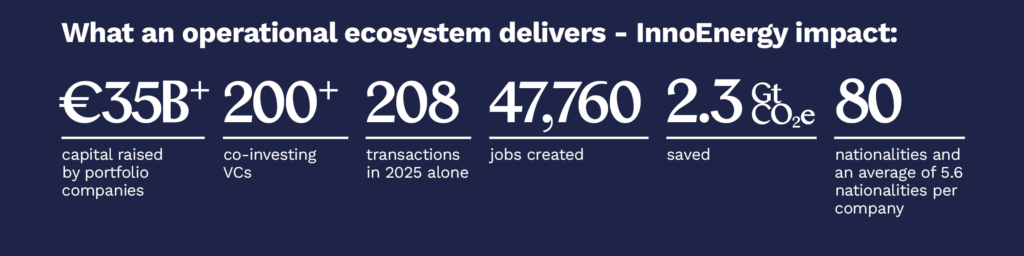
Facts are friends: The evidence is already visible. Across the InnoEnergy ecosystem, hundreds of venture and growth investors have co-invested, portfolio companies have raised tens of billions of euros, thousands of skilled jobs have been created, measurable CO₂ reductions have been achieved, and parallel investments have been made in workforce development through specialised education and training programmes.
Rebuilding such systems from scratch would take another decade — a decade Europe does not have. The surest path to success is therefore not to reinvent Europe’s scaling model, but to scale what already works: combining growth capital with proven, pan-European ecosystems that de-risk execution and convert investment into impact.
Europe’s tech future will not be funded into existence.
It will be built — and capital will flow fastest where it is best de-risked.
Download a pdf of the white paper here
Authors
Elena Bou is an Executive Board Member of InnoEnergy. She co-founded InnoEnergy with the idea of creating a trusted ecosystem that would reduce the innovation gap in the sustainable energy field and, therefore, accelerate the energy transition. In 2023, she was awarded the Nobel Sustainability Trust’s (NST) Sustainability Award in the category of “Outstanding Research and Development in the Field of Energy”. Elena is also an Associate Professor at ESADE Business School.
Francisco Velázquez de Cuéllar is the Founder of Axon, an investment house specialised in growth technology-driven companies scaling across Europe and internationally. He has deep experience in supporting scale-ups through complex growth phases, combining capital, governance and strategic execution to build resilient, long-term businesses. Francisco has also served in the past as a board member of the European Innovation Council.
Sources
- EQT (2026): Attention is just the start. eqtgroup.com/thinq/opinion/seizing-europe-strategic-tech-opportunity.
- Scaleup Europe Fund – European Innovation Council European Commission (2025): Remaining financing gaps are being bridged by legislative initiatives to unlock growth capital and by efforts to allocate public funds more efficiently. Novel initiatives such as the soon-tobe-launched Scale Up Europe Fund will bring another public-private element to the EU toolbox. https://eic.ec.europa.eu/eic-fund/scaleup-europe-fund_en
- Draghi (2024). The Draghi report: A competitiveness strategy for Europe. https://commission.europa.eu/topics/competitiveness/draghi-report_en#paragraph_47059.
- World Economic Forum (2025). Scaling the Industrial Transition: Hard-to-Abate Sectors and Net-Zero Progress. https://www.weforum.org/publications/scaling-the-industrial-transition-hard-to-abate-sectors-and-net-zero-progress-in-2025/
- European Commission (2025). Innovation Fund Knowledge Sharing Report. https://op.europa.eu/en/publication-detail/-/publication/1ba2af02-62be-11f0-bf4e-01aa75ed71a1.