Clean tech industries are set to attract 5 trillion euros in annual investment by 2035, creating significant economic and employment opportunities (McKinsey, 2025). At the same time, clean tech value chains are becoming more complex, while competition for skilled talent is intensifying.
For European companies, capturing a meaningful share of this investment will depend not only on technology and capital, but on having the talent required to deliver projects at scale.
Building the skills to scale, therefore, becomes a strategic priority. This article outlines four ways clean tech leaders can future-proof their workforce by aligning transferable skills, digital capabilities, skills intelligence and continuous upskilling pathways to support long-term growth.
1. Understand the Growing Complexity of Clean Tech Value Chains and Where Skills Gaps Matter Most
Clean tech industries have evolved into interconnected value chains that span from raw material extraction to end-of-life recovery. Clean tech value chains now share common processes, digital systems and technical capabilities, such as diagnostics, system integration, and automation. As a result, many skills are increasingly transferable across sectors, creating opportunities when managed strategically.
These transferable skills support greater workforce agility at a time when talent shortages are intensifying. According to LinkedIn’s Economic Graph, global demand for green skills is growing at more than twice the rate of supply, increasing the risk of project delays and cost overruns for organisations under delivery pressure.
Not all workforce shortages carry the same risk. Understanding how critical and high-demand roles affect operations differently is essential for effective workforce planning and investment decisions:
- Critical job roles: are essential for the operation, optimisation, and strategic development of clean tech systems. These positions require high-level expertise, advanced technical skills, or specialised qualifications. The absence of such roles would significantly impact project feasibility, system performance, or long-term sector growth.
- High-demand job roles: include roles with rapidly growing workforce needs due to technology deployment, market expansion or policy acceleration. These positions are typically more operational or implementation-focused and, while they may not require the same depth of specialised expertise as critical roles, they are important for ensuring that projects are delivered on time and at scale.
Recognising this distinction helps decision makers identify where skills shortages could halt operations and where gaps are more likely to slow expansion or increase costs, while enabling more efficient use of training budgets.
Effective workforce planning therefore requires distinguishing between critical roles that need continuity through targeted retention and specialist training, and high-demand roles that call for volume upskilling and cross-sector recruitment. Examples of critical and high-demand job roles in clean tech industries:
| Critical jobs roles | High-demand job roles |
| Battery Systems Engineer | Solar PV Installer |
| Solar Operations and Maintenance Engineer | Battery Assembly Operator |
| Hydrogen Systems Engineer | Hydrogen Technician |
| Grid Integration Specialist | Biogas Plant Operator |
| Wind Turbine Design Engineer | Wind Turbine Service Technician |
2. Respond to the forces reshaping workforce demand, including digital skills, AI, automation, and the human factor:
Digitalisation is affecting nearly every clean tech job function across manufacturing, installation, operations and maintenance. Digital, automation awareness, AI and cybersecurity-oriented skills, along with data interpretation, are increasingly baseline expectations across most segments. This trend shows nuanced differences across sectors; for instance:
- In the solar sector, remote asset monitoring, supervisory control and data acquisition (SCADA) systems, data-driven diagnostics, predictive and preventive maintenance, cybersecurity, robotics oversight and digital commissioning tools are increasingly required.
- In the battery sector, manufacturing execution systems (MES), AI-driven process control, digital twins, and automated quality inspection are increasingly expected in production and maintenance roles.
- In the hydrogen sector, SCADA supervision, leak detection sensors, and AI-enabled process optimisation are integral to plant operation and pipeline management.
The ability to scale clean tech operations increasingly depends on whether organisations can build the right skills fast enough. According to the Future of Jobs Report 2025, 90% of clean tech employers expect to prioritise upskilling or reskilling by 2030. AI and big data are projected to see the fastest growth in energy technology and utilities, while AI and Machine Learning Specialists are projected to see the highest job growth.
This focus on skills is also reflected in broader business priorities. Over the next five years, senior strategy leaders identify the rollout of AI and emerging technologies, alongside talent shortages and workforce transformation, as among the most influential forces shaping organisational strategy (World Economic Forum, 2026). The implication is clear: competitive advantage will increasingly depend on how quickly organisations can build the skills needed to deploy these technologies effectively. With only four years left to hit these goals, the urgency is clear: organisations that want to scale must act now. This is precisely where InnoEnergy Skills Institute creates value, equipping clean tech businesses with the essential skills required to thrive in a fast-evolving market.
However, digital capability alone does not guarantee safe, reliable, or scalable operations. Technology alone is not enough. In an era shaped by artificial intelligence and ongoing disruption, human capabilities remain central to sustained competitive advantage (World Economic Forum, 2026).
Effective communication, teamwork, adaptability, problem-solving, systems thinking, and a safety culture are integral to high-risk environments. Coordination on a gigafactory line, for instance, relies heavily on these behavioural skills. This reinforces the central role of the human factor in operational excellence, with employers increasingly treating these capabilities as key differentiators in hiring decisions.
3. Use Skills Intelligence Systems to Guide and Protect Investment Decisions
When organisations lack the right skills at the right time, the financial impact of this skills gap can be immediate. For example, a month of delay in a major project can result in millions of euros in lost revenue, higher contractor costs and missed incentive deadlines (Clean Energy Wire, 2024). This is where skills intelligence becomes essential.
Skills intelligence provides leaders with the clarity needed to prevent these issues, especially in complex value chains. A structured, intelligence-driven approach delivers measurable benefits across the entire ecosystem: Skills intelligence provides leaders with the clarity needed to prevent these issues, especially in complex value chains. A structured, intelligence-driven approach delivers measurable benefits across the entire ecosystem:
- Upskilling training providers can gain clarity on emerging demand and design modular courses targeting specific job roles and skill requirements
- Recruitment can align with skill profiles, reducing time to hire and minimising skills mismatches
- Organisations can invest more efficiently in targeted training for their staff
- Investments in training can become more concrete and evidence-based, maximising impact
- Professionals gain clearer pathways for career progression and can upskill in ways that directly align with industry needs
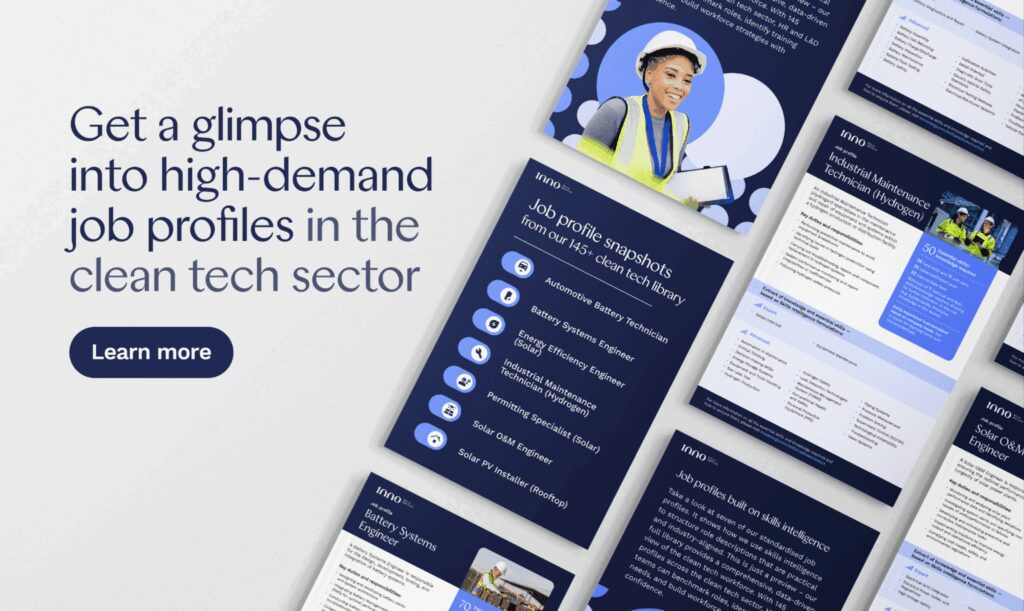
Without coordinated strategies, organisations risk competing for scarce talent, and project pipelines risk stalling as a result. This is where skills intelligence systems, such as InnoEnergy Skills Institute’s Green Skills Framework and Skills Taxonomy, can help, drawing on more than 145 job profiles and a list of nearly 3,000 sector-specific and cross-cutting skills across multiple clean energy sectors. Skills intelligence systems turn skills data into clear, actionable job profiles.
By bringing this level of clarity, skills intelligence strengthens workforce planning, reduces uncertainty in project execution and helps leaders direct investment to the areas with the highest return.
4. Move Beyond One-Time Training by Building Modular and Stackable Learning Pathways for Long-Term Workforce Readiness:
Clean tech evolves faster than traditional training models. The Future of Jobs Report 2025 identifies skills gaps as the most significant barrier to business transformation in the energy, technology, and utilities industries, cited by 81% of respondents. This reinforces the urgency of structured skills mapping and intelligence-driven training, particularly in complex value chains.
Continuous learning must be central to organisational strategy. Skills intelligence, combined with transferable skills and job-aligned training, is central to creating long-term, secure jobs and a resilient clean tech industry.
However, one-size-fits-all approaches are ineffective. Training must be targeted, role-specific, modular and stackable to keep pace with change. Modular courses allow workers to upskill without stepping away from their roles, building digital capabilities, technical knowledge or behavioural competencies as technologies evolve. These pathways expand talent pools and help mitigate bottlenecks.
To deliver on business growth and hit innovation and decarbonisation targets, organisations need more than technology. They need workforces that are ready to implement it. InnoEnergy Skills Institute’s Green Talent Accelerator helps leaders turn net-zero commitments into actionable workforce strategies. It connects role-specific job profiles, curated training and industry-recognised certifications into a structured system, accelerating workforce development and ensuring teams are prepared as projects launch or scale.
Sounds like the right approach for your organisation?
If you’re ready to align your workforce capabilities with your clean tech ambitions, our team can help. Get in touch with us to explore how the Green Talent Accelerator can turn your strategy into action.