During the World Economic Forum’s (WEF) Annual Meeting for 2026 in Davos, jobs and skills transformation were a central topic of discussion. These conversations highlighted how technological shifts, geopolitical volatility and the energy transition are reshaping labour markets in Europe and beyond.
The Future of Jobs Report 2025 (World Economic Forum, 2025) had already signalled the scale of disruption ahead. By 2030, it was projected that 170 million new jobs could be created globally, while around 92 million existing roles may be displaced.
In this year’s Davos discussions, leaders across business and policy reaffirmed a consistent concern: technological progress is moving faster than workforce preparedness. For clean tech value chains, these signals are especially important as workforce capability is now a determining factor in deployment speed and competitiveness.
Why insights from Davos 2026 matter
Clean tech depends increasingly on AI-driven innovation and specialised talent, which makes the jobs and skills transformation especially critical. Business leaders are under pressure to deliver growth and competitiveness at speed. At the same time, people growth leaders must work to close skill gaps as fast as possible and prove that training works.
This pressure is already visible in areas like the energy sector, where the availability of new skilled entrants is lagging behind operational requirements. International Energy Agency (2025) data indicates that the number of workers entering the energy sector would need to rise by around 40% by 2030 to keep the skills gap from increasing.
As clean tech becomes a central pillar of global economic growth, skills readiness will play a critical role in shaping the pace, quality and equity of the transition. “Understanding the forces reshaping jobs and skill requirements is essential for building resilient workforce strategies that can keep up with rapid technological change. Clean tech scaling will require accelerated investment in skills, and workforce readiness will strongly influence the speed, resilience and inclusiveness of the green transition,” says Dimitra Maleka, Project Manager and Skills Intelligence Specialist at InnoEnergy Skills Institute.

Understanding the forces reshaping jobs and skill requirements is essential for building resilient workforce strategies that can keep up with rapid technological change. Clean tech scaling will require accelerated investment in skills, and workforce readiness will strongly influence the speed, resilience and inclusiveness of the green transition.”
What do the World Economic Forum(wef) reports signal for 2030
The new WEF’s (2026) Report on AI and Talent sets out four scenarios shaped by two forces: the pace of AI advancement and workforce readiness. While their futures differ, one key feature remains: skills gaps persist and shape which organisations and regions will gain a competitive advantage. Faster technology uptake increases pressure on reskilling systems, while slower adoption limits productivity gains. In both cases, workforce readiness remains a critical challenge.
The analysis also highlights a mismatch between demand for technical skills, particularly in AI-related roles, and the pace of skills development. Frontier technologies such as automation and robotics are already reshaping roles, but by 2030, the scale and pace of job redesign will be undeniable. In the Future of Jobs Report 2025, a net increase of 78 million jobs was also indicated, underscoring the need for urgent workforce upskilling.
At the company level, the effects of this disruption are already taking shape. Employers expect nearly 40% of core job skills to change within five years, and almost 80% say reskilling and upskilling are critical to business strategy.
As industries adapt to technological, demographic and geopolitical change, long-term competitiveness increasingly rests on investment in human capability. Traits such as adaptability, creativity, collaboration, leadership and sound judgement matter more than ever because they support stable performance under pressure, particularly in complex environments.
This is highlighted in the report “New Economy Skills: Unlocking the Human Advantage” (WEF, 2025), which explains why the “human advantage” becomes increasingly important as tasks shift. It argues that competitiveness will increasingly depend on how effectively organisations cultivate talent and human potential, especially amid uncertainty and change. This is reflected in the growing employer demand for skills such as adaptability and problem-solving, which remain less visible and less standardised in current job and training frameworks.
What does this mean for clean tech workforce readiness
Many of the themes raised in Davos 2026 echo trends InnoEnergy Skills Institute has been tracking within clean tech value chains. The real test, however, lies in translating these signals into practical workforce decisions. This is not straightforward in a context of geoeconomic uncertainty, which complicates both strategic planning and talent development.
Yet within this environment, clean tech has structural strengths. Its value chains are highly interconnected, with processes and technical capabilities overlapping across sectors. As Dimitra Maleka notes, “These intersections can form cross-cutting ‘skill clusters’. When we understand where skills overlap, we can build training pathways that can support faster, more flexible workforce growth.” When clearly mapped, they help professionals to transition into adjacent roles with less retraining, supporting mobility and improving organisational responsiveness.
However, this flexibility only works if critical roles can scale at the pace projects require. When they do not, the operational risks become visible very quickly:
- Slower commissioning and delayed go‑live
- Downtime and reduced yield when maintenance capacity is stretched
- Rework and quality issues when process control skills lag
- Compliance challenges when competence evidence is inconsistent
- Increased safety risks when training varies across sites and contractors
For clean tech leaders, the priority is clear: translating workforce readiness into a strategic advantage in an increasingly complex operating environment.
How InnoEnergy Skills Institute helps build job-ready green talent
A central challenge Davos highlighted is speed-to-competence. Organisations need faster, more reliable routes to job-ready talent that match real roles in clean tech value chains.
That is the focus of the InnoEnergy Skills Institute. Our approach combines skills intelligence, job frameworks and modular training to make skills visible and deployable. With industry-recognised certifications, organisations can quickly equip their teams with the critical skills to thrive in a fast-evolving industry.
Job frameworks clarify what competence looks like for a specific role. Modular learning then builds capability in stackable units that fit around operational reality. This helps to reduce downtime and maintain momentum.
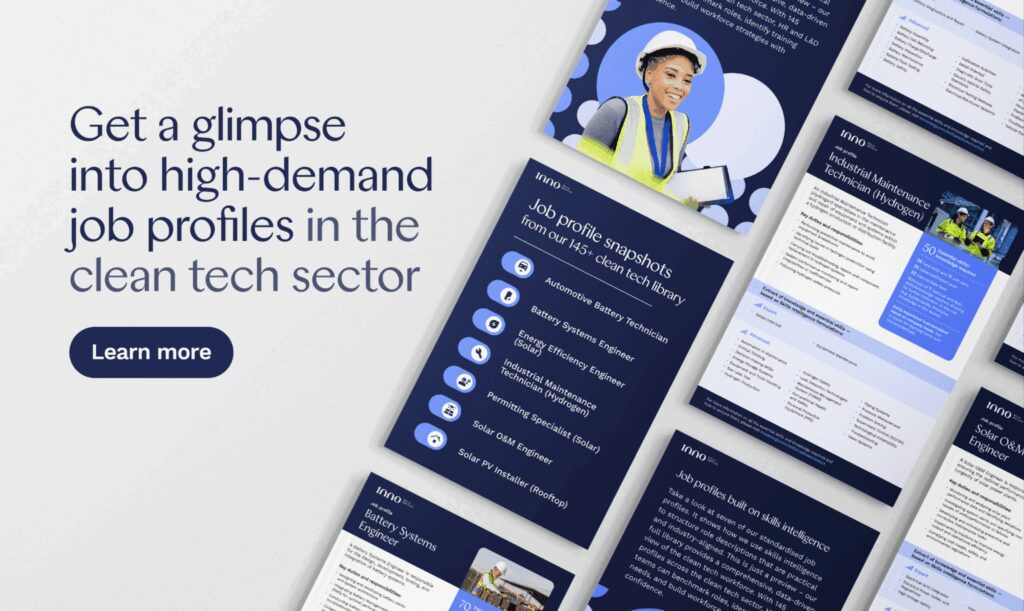
InnoEnergy Skills Institute’s Green Talent Accelerator is a structured framework for upskilling your existing workforce in clean tech. It connects role-specific job profiles to the exact skills, training, and certifications needed, ensuring every employee can perform to recognised industry standards.
Sounds like the right approach for your organisation?
If you’re ready to align your workforce capabilities with your clean tech ambitions, our team can help. Get in touch with us to explore how we can support your workforce readiness.