Open-water deployment of the 1:10-scale prototype validates key system functions and advances development of the Mobula® 25 MVP and the full-scale Mobula® 50 turbine.
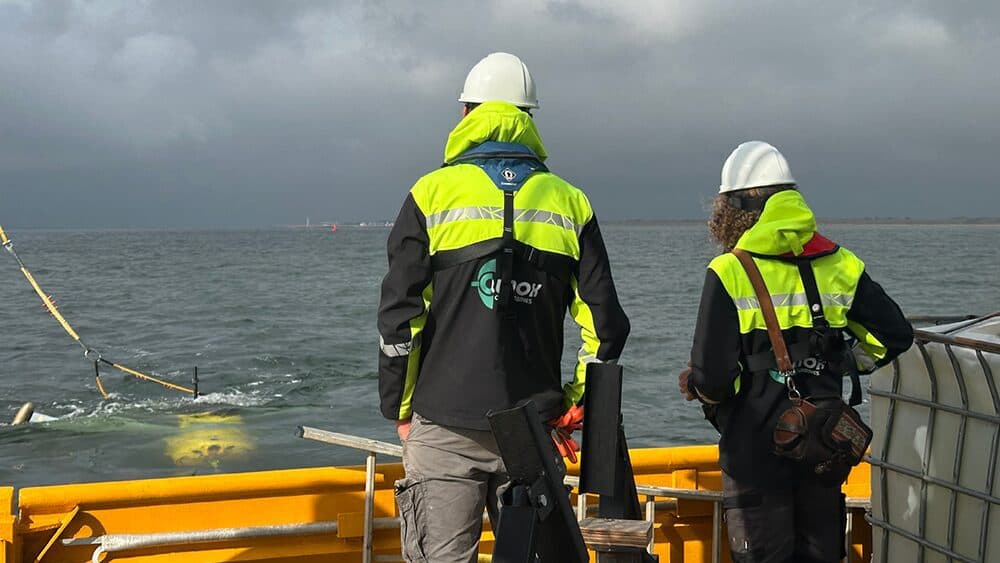
InnoEnergy portfolio company Equinox Ocean Turbines (EQOT) has successfully completed open-water testing of its Mobula® 5 prototype at Marsdiep near Texel, the Netherlands — the first time the turbine has been deployed and operated outside a controlled testing environment.
“We are proud and excited to have reached this milestone,” said Pieter de Haas, CEO and CTO of EQOT. “The open-water tests confirmed key aspects of the system’s design and performance, giving us valuable operational experience and confidence as we move towards our next development phase.”
The Mobula® 5 was successfully deployed and recovered, with controlled diving and surfacing demonstrating the performance of its attitude-control system. The team also started and stopped the rotor and generated electrical power, validating the drivetrain, power take-off (PTO), and generator as an integrated system. Following the campaign, EQOT’s technology has advanced to Technology Readiness Level 6 (TRL 6) — demonstration of a prototype system in a relevant operational environment — providing an important technical foundation ahead of larger-scale deployment.
“For investors in emerging energy technologies, milestones like this are significant because they test more than the technology itself,” said Jacob Ruiter, CEO Benelux and UK at InnoEnergy. “They test whether years of engineering assumptions, modelling and component-level validation translate into performance in the real world. The successful Mobula® 5 campaign provides EQOT with important operational evidence as it progresses towards larger-scale systems.”
The Mobula® 5 is a precursor to EQOT’s next-generation systems. The company is now progressing the Mobula® 25 minimum viable product (MVP), with deployment planned for 2028. In parallel, preparations are underway for the Mobula® 50, a planned 2 MW full-scale turbine targeted for 2030, alongside continued site selection and commercial development with potential partners and customers in regions influenced by the Gulf Stream off the United States, the Kuroshio Current off Japan and the Agulhas Current off South Africa.
Ocean current energy offers a predictable complement to more variable renewables such as wind and solar. In regions around the world with strong, persistent ocean currents, it can provide a reliable source of renewable electricity and open up new opportunities for clean power generation.