Solar is maintaining strong global momentum, with China leading global capacity additions and Europe continuing to expand. The IEA forecasts that solar PV will account for around 80% of global renewable capacity growth to 2030.
In Europe, the EU Solar Jobs Report 2025 notes a brief slowdown, even as the workforce reached 865,000 people in 2024. Yet this is not a story of decline: with the right policies for solar and storage in place, the report indicated that employment is expected to recover from 2026 and reach more than 916,000 jobs by 2029.
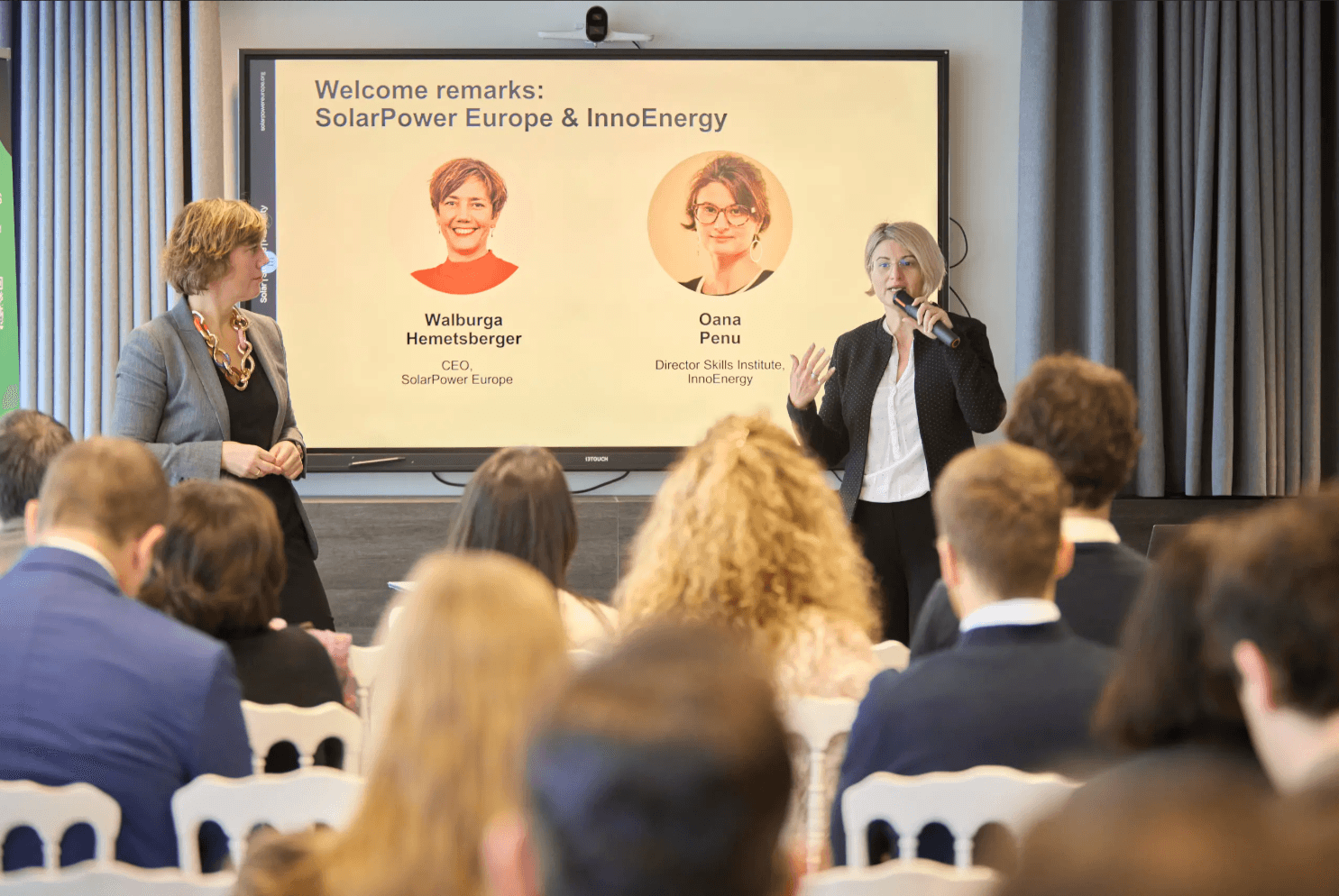
The real question now is how rapidly the continent can build the workforce behind it. This was the focus of the recent Solar Jobs & Skills Day in Brussels, co-hosted by SolarPower Europe and the InnoEnergy Skills Institute. Here, policymakers, industry leaders and training providers came together to examine how skills can become Europe’s strategic advantage.
The conversations yielded numerous takeaways; five of these offer a useful lens on the opportunities and risks ahead:
1) Europe Needs a Skills-First Approach to Solar Growth
Achieving Europe’s solar goals requires placing skills development at the centre of the transition. Oana Penu, Director of the InnoEnergy Skills Institute, connected today’s labour-market signals to tomorrow’s energy sovereignty. Solar, she argued, is set to become a pillar of Europe’s energy system, particularly when paired with storage. “We have the unique opportunity to make solar the backbone of the European energy mix,” she said.
However, technology alone cannot deliver Europe’s ambitions. Many of the roles that will matter most along the solar value chain do not yet exist. That means preparing for continuous learning, building systems that recognise skills and ensuring mobility schemes allow workers to move where demand emerges rather than being fixed in local markets.
Penu also returned to a theme that underpinned the day: progress requires investing ahead of certainty. Early lessons from the European Battery Alliance Academy, the first Net Zero Industry Academies, show that pilot programmes will not always be perfect, but early action can still accelerate capability. Waiting for perfect alignment risks slowing the transition when Europe can least afford delay.
2) Lay the Foundations for Scalable Solar Skills
The European Solar Academy (ESA Academy), as one of the EU’s Net Zero Industry Academies, reflects that mindset: build infrastructure now so that skills can grow with the market.
Rather than adding another layer of project-by-project training, the Academy is committed to transforming the EU workforce for the solar industry, revolutionising upskilling and reskilling across the solar PV value chain. It maps the critical roles across the value chain, defines the competences behind each one and uses these insights to shape learning journeys delivered online, in person or through blended formats.
Jacqui Wigg, Solar Learning Product Manager at the InnoEnergy Skills Institute, remarked that following the European Battery Alliance Academy, the lessons learned are now being applied to reskill and upskill for the needs of Europe’s future solar workforce. “Skills are both a challenge and an opportunity. With investment and coordination, we can create competitive jobs, ensure safety and accelerate the net-zero transition. A long-term workforce strategy with strong EU-level coordination is essential,” she highlighted.
Crucially, the European Solar Academy works with member states, industry associations and training providers to scale what already exists and to fill gaps where needed. An Advisory Council of industry, education and policy voices keeps the Academy aligned with real market demands. As council member Oier Bolibar put it, the goal is to “join up the dots” so that solar skills development aligns with industrial reality.
3) Standardising Skills to Unlock Cross-Border Mobility
Clearly identifying which roles are, and will be, prioritised in the solar sector is key to equipping businesses in the clean tech industry with the critical skills needed to thrive in a fast-evolving market.
The Academy’s work casts a clearer light on where Europe must move faster. Consider rooftop installers: training remains fragmented, with uneven national standards and limited mutual recognition of qualifications. Given that rooftop installers are the largest job group in the sector, harominsing training and certification is essential. SolarPower Europe and InnoEnergy are now working to align curricula, a step that also helps address one of Europe’s key challenges: enabling cross-border mobility. This also requires coherent certification strategies to ensure skills can move across Europe rather than being developed in silos.
The Academy’s Council plays a key role in preventing siloed efforts, bringing industry, education and policy together to set standards and align training with sector needs. As Jacqui Wigg, Solar Learning Product Manager at the InnoEnergy Skills Institute, highlighted, remaining responsive is essential: “We can’t dictate demand, so this is a challenging target. But what we can do is stay responsive to changing needs and keep making our offerings more resilient.”
4) Restore Europe’s Manufacturing Know-How Through Strategic Skills Development
Industrial know-how is another pressure point. Europe once led PV manufacturing, but much of that expertise has since migrated to Asia. Elise Bruhat, Technical Partnerships Director at Holosolis, described the task ahead: “We actually lost a lot of knowledge that was shipped to China, and now we need to actively reshore and recreate it.” Early investment, she argued, must accompany clear industrial targets and harmonised standards.
Rebuilding this industrial know-how requires preparing today’s workforce for the realities of tomorrow’s factories. As PV manufacturing becomes one of the most automated segments of the energy industry, the priority is to help workers from other sectors transition into roles shaped by digitalisation, robotics and AI.
This shift also strengthens Europe’s ability to reshore PV manufacturing by reducing the labour intensity of production and making competitiveness more attainable. As Elise Bruhat explained, this is why efforts are also focused on designing training centres where workers can learn directly in environments that mirror the factories of the future.
Restoring Europe’s industrial know-how is also an opportunity to broaden participation in the sector. A future-ready workforce must be more diverse than today’s. For example, in efforts to reduce the gender gap, Kristi Ghosh from Clean Energy Trio Advisory highlighted that mentorship and initiatives such as Women in Solar can play a decisive role in making the industry more attractive and accessible to women. Bruhat’s experience in France reinforces this point: once women without industrial backgrounds became aware of available training pathways, their interest in technical roles increased significantly.
5) Prepare Today’s Workforce for Automation and Tomorrow’s Roles
The shape of solar employment is also evolving. While deployment will continue to account for most jobs in Europe, Elias Paul, Head of Operations at the InnoEnergy Skills Institute, noted that manufacturing may expand if supported by the right policies. By the 2030s, roles will expand across operations, maintenance, and recycling as systems reach the end of their lifespans.
Automation will influence every layer of the value chain. People will still be essential, but their roles will shift towards problem-solving, systems thinking and working alongside digital tools. As Paul noted, “It is not just about working alongside robots; that is only one aspect of it. The other is identifying the skills that humans working in these environments will need, such as problem-solving and adaptability.”
He emphasised the need for micro-credentials and flexible curricula that allow workers to upskill continuously, as well as recognising adjacent competences from sectors such as HVAC, automotive and logistics. When policy, training and industry align, he noted, the impact can multiply far beyond the sum of each contribution.
Skills as Europe’s strategic advantage
The conversations in Brussels pointed to a single conclusion: skills sit at the centre of Europe’s solar ambition. They are where the risks are most visible, but also where the greatest opportunity lies.
Through initiatives such as the European Solar Academy, Europe is advancing a comprehensive upskilling strategy aimed at closing critical workforce shortages that can put the clean energy transition and the continent’s competitive position at risk. But the task extends well beyond the solar sector. This initiative forms part of a broader suite of community programmes led by InnoEnergy Skills Institute led by InnoEnergy Skills Institute, designed to drive the energy transition through impactful initiatives that educate, inspire, and accelerate adoption.
By turning policy into accessible learning pathways and strengthening alignment between citizens, industry and Europe’s transition goals, these programmes illustrate how capability-building becomes a strategic advantage. A strong, adaptable workforce will be key to sustaining Europe’s momentum and securing long-term energy sovereignty.