Across clean tech industries, the scale and structure of workforce demand are shifting. Recent analyses estimate that approximately €5 trillion in capital investment could flow into clean tech annually by 2035 (McKinsey, 2025), potentially creating employment opportunities for 25-30 million people globally.
At the same time, the Future of Jobs Report from the World Economic Forum (2025) indicates that half of employers plan to reorient their operations in response to AI, and two-thirds intend to hire talent with specialised capabilities. For engineers, technicians, and specialists exploring upskilling options, this shift opens new career pathways and opportunities.
Many technical skills, such as materials engineering and power electronics, are increasingly transferable across sectors. Clean tech industries now operate through interconnected value chains that span from raw material processing to end-of-life recovery, with each stage requiring a wide mix of engineering, digital and operational roles.
In the battery sector, this includes raw material refining, electrode coating, cell manufacturing, module and pack assembly, system integration and end-of-life recovery, each requiring distinct yet complementary expertise. Solar technologies follow a similar pattern, from photovoltaic cell manufacturing and module assembly to inverter integration, mounting systems, grid connection and panel recycling.
These overlaps create identifiable cross-cutting “skill clusters” that allow professionals to move into related roles with only limited retraining, thereby supporting workforce mobility and efficiency, as shown in the examples below (non-exhaustive):
| Examples of skills clusters | Example of specific skills | Sectors applied |
| Monitoring and diagnostics | Sensor calibration, fault detection, root cause analysis, predictive maintenance, performance monitoring | Energy Storage, Solar, Wind, Hydrogen, Geothermal, Biogas, Biofuels, Biomass, Wave and Tidal |
| PLC / Automation programming | Program PLC controllers, optimise automated production, optimise plant processes, implement automation processes, process control loops | Energy Storage, Solar, Wind, Hydrogen, Geothermal, Biogas, Biofuels, Biomass, Wave and Tidal |
| Digital skills and data analysis | SCADA system operation, cloud-based performance, IoT sensor data analysis, predictive analytics, performance optimisation, implement ML/AI for optimisation and predictive maintenance, OT cybersecurity monitoring | Energy Storage, Solar, Wind, Hydrogen, Geothermal, Biogas, Biofuels, Biomass, Wave and Tidal |
Digitalisation is reshaping clean tech work
Digital transformation is changing the day-to-day reality of clean tech jobs across manufacturing, installation, operations and maintenance. Basic digital literacy, automation awareness, cybersecurity awareness, and data interpretation are increasingly considered as baseline requirements across most clean tech roles.
The Future of Jobs Report 2025 (World Economic Forum, 2025) finds that AI and big data skills will see the fastest rise in demand by 2030 within the energy technology and utility industries, with AI and Machine Learning Specialists projected to experience the highest job growth. For instance, in the hydrogen sector, SCADA supervision, leak detection sensors and AI-enabled process optimisation are integral to plant operations and pipeline management, while in the wind sector, drone-based blade inspections and digital maintenance planning platforms are increasingly reshaping maintenance and service roles.
These are only a few examples of how roles are evolving. Digitalisation is reshaping many profiles, blending traditional engineering expertise with data skills and digital tools to create new hybrid roles across the sector.
However, digitalisation is only one of several forces at play. The rapid pace of technological change, combined with differences in adoption across regions, technologies and markets, makes the future shape of clean tech jobs difficult to predict. What is certain is that some roles will shift, and professionals who build these capabilities will be more likely to move into new roles as the sector evolves.
Human skills remain central to safe and effective operations:
Human skills remain central to clean tech work. Alongside technical knowledge, roles rely on communication, teamwork, adaptability, problem-solving, and a strong safety mindset, especially in high-risk settings such as battery production, hydrogen handling, or wind maintenance.
For example, coordination between engineering teams on a gigafactory line relies heavily on problem-solving and communication. Employers increasingly identify these attributes as key recruitment differentiators.
These skills also help people move from sectors such as oil and gas, construction or automotive into clean tech with targeted upskilling.
A framework that brings structure and clarity:
Many employers say one of their biggest barriers to expanding clean energy is not technology, but the difficulty of finding people with the right skills. Without a structured approach, job descriptions, skills mapping and training programmes can become fragmented.
Projections from LinkedIn’s Economic Graph suggest that the green skills deficit could more than double by 2050, meaning demand for green-skill roles may be more than twice the number of qualified workers1. This reinforces the need for structured skills mapping and training approaches that reflect the complexity of clean energy value chains.
A consistent framework helps address this by allowing organisations to:
- Define job roles and required skills using common terminology
- Measure skill gaps more effectively
- Design targeted training programmes aligned with industry needs
Taken together, skills intelligence helps organisations move beyond one-size-fits-all training by keeping skills, job roles and training solutions aligned as clean tech value chains evolve
How Skills Taxonomy and Green Skills Framework support the sector
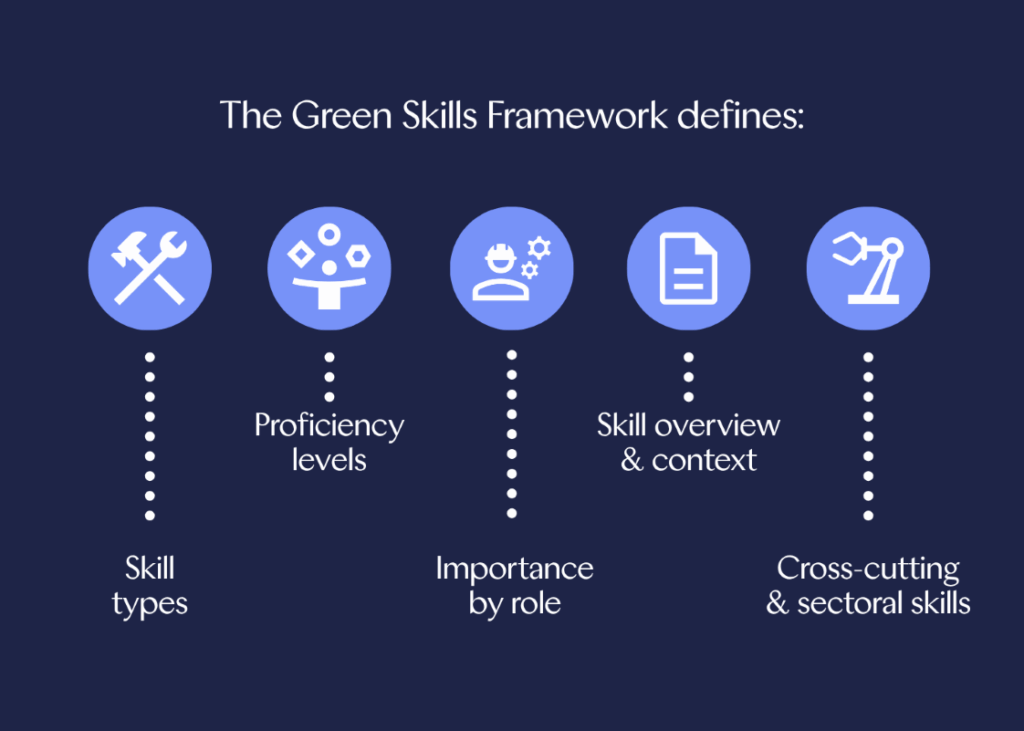
The InnoEnergy Skills Institute’s (IESI) Skills Taxonomy and Green Skills Framework provide structure for this challenge. It’s aligned with the European Skills, Competences and Occupations classification (ESCO), supporting consistency and recognition, while extending beyond it to capture nearly 3,000 sector-specific and cross-cutting skills across multiple clean energy sectors.
With particular emphasis on battery, solar and hydrogen, it identifies which skills are unique to each sector and which are transferable, and is continuously updated as technologies evolve.
Building on the Skills Taxonomy, the IESI Green Skills Framework adds a four-level system that shows what type of skill it is, how advanced each skill needs to be, how important it is, and how it relates to particular job roles. This granularity enables precision in matching skills to training modules and targeted upskilling. To get an idea, you can download this Job Profile Snapshots, which include examples to help you understand how the framework works.
Turning insight into action
With clean tech roles evolving, staying competitive means building the skills that industry now demands. The Green Talent Accelerator gives organisations a clear path to upskill with confidence. It is a structured framework for upskilling your existing workforce in clean tech, grounded in real labour-market intelligence and aligned with the roles shaping Europe’s energy transition.