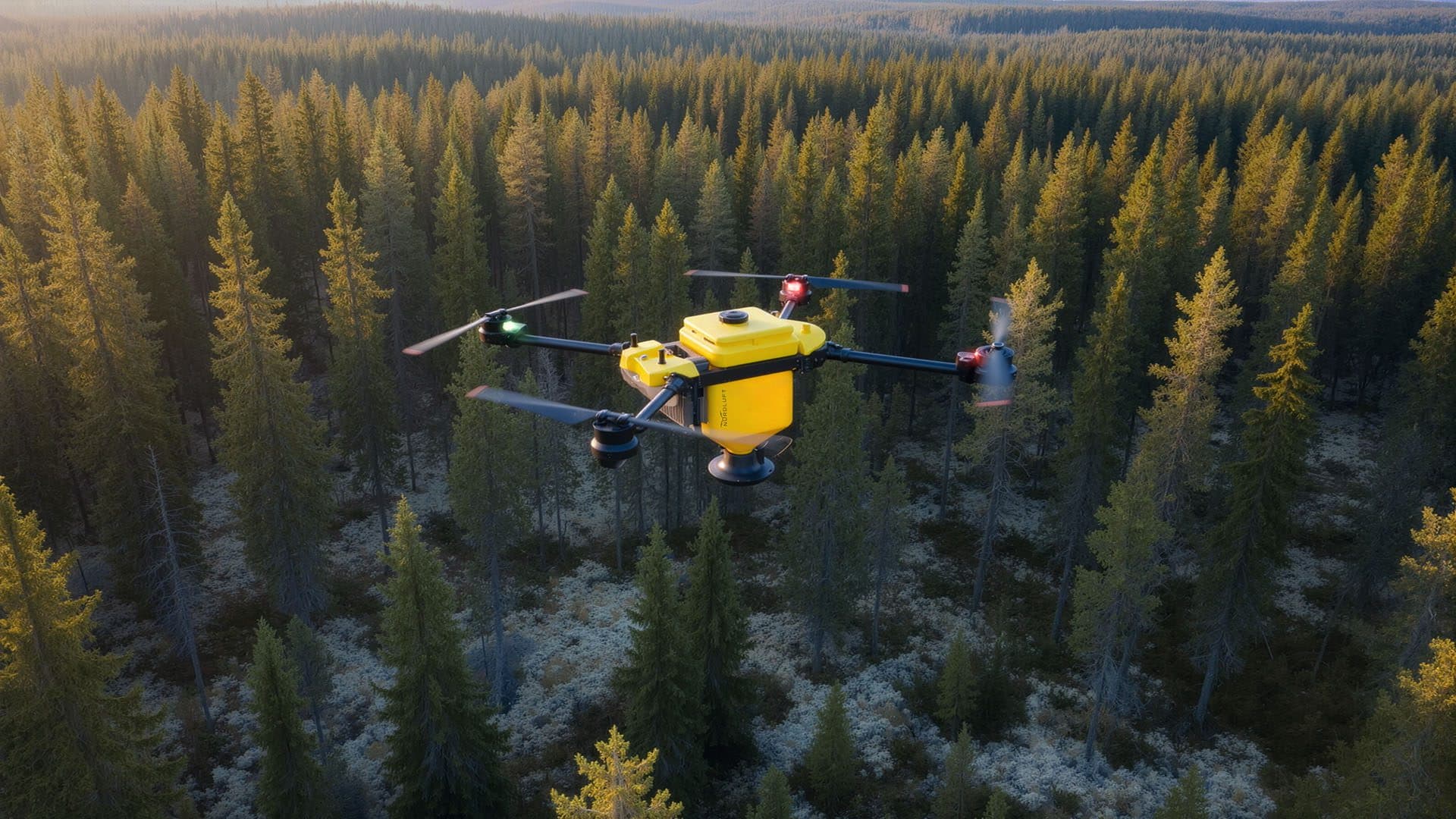
Swedish technology company Nordluft has received a unique flight permit for advanced drone operations in forest environments, marking an important step towards the use of heavy-lift drones for precision spreading in forestry.
The permit enables Nordluft to fly larger drones beyond visual line of sight, operate several drones with one pilot, and spread material within the approved area. According to the company, it is believed to be the first regulatory approval in Europe for this type of advanced drone-based forestry operation.
The permit is initially valid for an area north of Stockholm, where the company is now testing and verifying its system in the field. The next step is to expand the approved operating area to the locations where Nordluft plans future spreading operations together with its forestry partners, with approvals expected in the coming weeks.
“This is a breakthrough,” says Elof Winroth, CEO and founder of Nordluft. “We can now fly our larger drones beyond visual line of sight and test the system in the field in a way that has not been possible before. It takes us closer to our goal of using drones for spreading operations in forestry at larger scale.”
Making difficult forest areas easier to reach
Nordluft’s technology is developed for the precision spreading of fertilisers and bio-ash in forest environments, where difficult terrain, long distances and high mobilisation costs often limit the use of conventional methods such as ground machinery or helicopters.
By combining electric heavy-lift drones with proprietary control and logistics software, Nordluft aims to make aerial material handling more accessible, precise and efficient, including in areas that are too difficult to reach from the ground or where helicopter use is not economically viable.
According to the company, the technology could reduce spreading costs by up to 50% once in commercial operation.
The need is significant. Nordluft estimates that around 560,000 hectares of forest across the Nordics could be relevant for fertilisation, including around 200,000 hectares in Sweden. The company also sees an additional opportunity in bio-ash recycling, estimated at around 145,000 hectares across the region. Together, these applications represent a market potential of more than SEK 700 million.
Working with leading forestry companies
Nordluft is already collaborating with several of Sweden’s largest forestry companies, including SCA, Holmen and Kopparfors Skogar. The partnerships cover technology development, field validation and preparations for future use in forest environments.
“We see great potential in Nordluft’s high-precision drone-based spreading,” says Jonas Eriksson, Head of Forest and Land at Holmen. “Nitrogen fertilisation is an important method for increasing forest growth, and better control can deliver the same effect with less input. This creates opportunities for both increased growth and improved resource efficiency in forestry.”
For Nordluft, these partnerships are central to turning the permit into practical deployment. The company is now using the approved area to continue testing the system in real forest conditions, while preparing for the next operational phase together with industry partners.
“Our ambition is to make aerial material handling more accessible and efficient,” adds Elof Winroth. “This permit allows us to continue working in the field and prepare for commercial operations.”
Building the foundations for larger-scale drone operations
For InnoEnergy, which has supported Nordluft since 2018, it reflects the growing maturity of industrial drone applications and the increasing potential of autonomous aerial operations in sectors where accessibility, distance and operational efficiency remain major challenges.
“Nordluft is addressing a very practical challenge in forestry with a solution that combines electrification, automation and deep operational understanding of the sector,” says Sara Hjortmar, Investment and Asset Manager at InnoEnergy Scandinavia. “This permit is an important validation point for the company. It shows that Nordluft is not only developing a promising technology, but also building the regulatory and operational foundation needed to bring it into real field use.”
While forestry is Nordluft’s first focus market, the company also sees future opportunities in agriculture and other sectors where accessibility, precision and efficient material handling remain operational challenges.
“Forestry is the starting point, but we see strong potential for this type of technology well beyond that,” adds Sara Hjortmar.