Europe’s renewable energy transition is no longer limited by technology. The sector has the solutions, the investment momentum and the policy direction. The harder question is whether Europe can build the workforce to scale them.
This was the focus of the European Sustainable Energy Week (EUSEW) 2026 policy session “Building skills for a competitive renewable energy future”, co-hosted by RESkill4NetZero, represented by InnoEnergy Skills Institute, and the Renewable Energy Skills Partnership, represented by GCP Europe. Hosted in Brussels and online, EUSEW, the largest event in Europe dedicated to renewables and efficient energy use, took place from 9 to 11 June 2026.
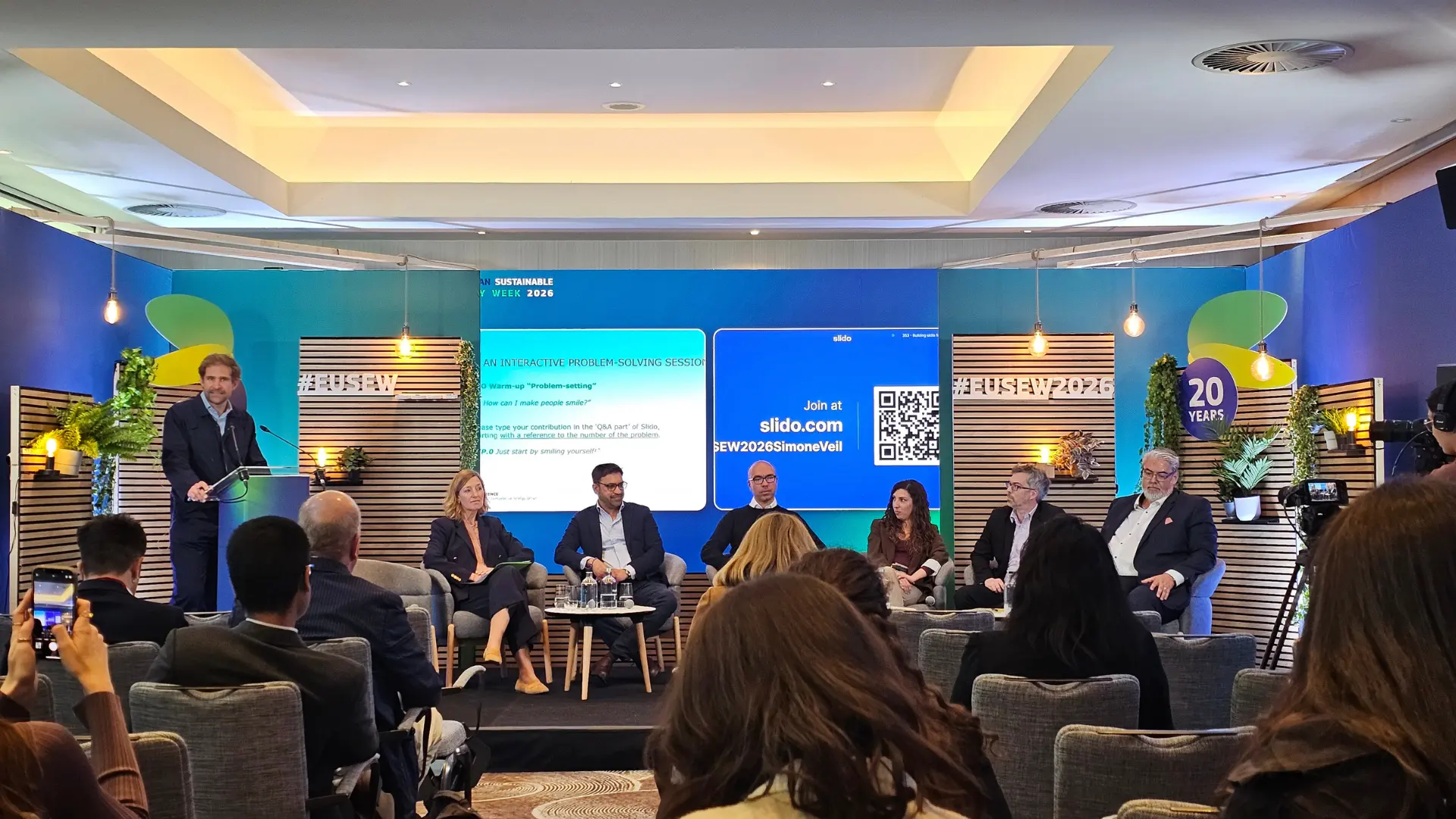
Rather than a traditional panel, the session was run as a practical problem-solving discussion. Participants brought real workforce challenges, and speakers from policy, industry, training and labour market intelligence worked through what it takes to move from skills ambition to workforce delivery. The discussion pointed to a clear conclusion: Europe needs training that is faster, more modular and tied to real jobs.
“Today we don’t have a technology problem. What we have is a scaling problem“, Elias Pau, Head of Operations at InnoEnergy Skills Institute
1. The skills gap is already affecting delivery
The renewable energy workforce challenge is often treated as a future risk. The session made it clear it is already here. Across the energy sector, organisations face critical hiring bottlenecks, particularly in technician and specialised engineering roles. Half of energy organisations now report such bottlenecks (IEA, 2025), and demand for workers across the battery, solar, wind, hydrogen and heat pump value chains is running at roughly twice the available supply. These are not peripheral gaps. They affect the people needed to build and operate the systems behind the transition.
Elias Paul, Head of Operations at InnoEnergy Skills Institute, framed human capital as one of the most important assets a company holds, even if it never appears on the balance sheet. Without the right people, clean technology cannot move from ambition to deployment at the pace Europe requires. This echoed the opening contribution from Eva Schultz, Member of the Cabinet of the European Commission Executive Vice-President Roxana Mînzatu, who stressed that energy and skills must be treated together rather than as separate policy areas: “There is no competitiveness without a competitive skills base.”
Labour market data points in the same direction. According to Mirek Pospišil, Public Policy & Economic Graph Lead at LinkedIn, the share of job postings requiring green skills is growing by 8.0% year-on-year, compared with 4.3% growth in the share of workers who hold them.
For the first time, professionals with green skills in non-green job titles make up 53% of all green hires, a sign that green skills are spreading across the workforce rather than remaining confined to specialist roles.
The skills gap in numbers:
| Figure | What it means | Source |
| Half of energy organisations report critical hiring bottlenecks | Hiring shortfalls, concentrated in technicians and specialised engineers, are a present constraint, not a future risk. | IEA, 2025 |
| Green-skill job postings are growing 8.0% year-on-year, against 4.3% growth in workers who have them | Demand for green skills is growing about twice as fast as supply, widening the gap each year. | LinkedIn, 2025 |
| ~+40% of graduates entering the energy sector need to prevent skills mismatch from worsening by 2030 globally | Without a larger inflow of young entrants, the mismatch widens and roles go unfilled as the sector scales. | IEA, 2025 |
| Employers predict nearly 40% of the core skills required to do jobs will be disrupted in the next five years | Skills transformation means training cannot be a one-off; workers need continuous reskilling to keep pace. | World Economic Forum, 2025 |
| 53% of all green hires are professionals with green skills in non-green job titles | Green skills are diffusing across the whole workforce, not just specialist roles. | LinkedIn, 2025 |
| Women hold around 43% of jobs across the economy, but only around 30% in renewable energy | The under-representation of women is a direct constraint on the sector’s capacity to expand. | IRENA, 2025 |
2. Start with the job, not with the course
Formal education systems remain essential, but on their own, they are often too slow to respond. Elias Paul pointed out that modular training, micro-credentials, employer councils and cross-sector mobility can close the gap between demand and supply more quickly.
This matters given how fast the market is changing. The World Economic Forum (2025) projects around 170 million new jobs across the global economy by 2030, and the displacement of about 92 million, so the roles people train for will keep shifting. A job-first approach answers this. It means mapping the occupational profile first, identifying the technical and transversal skills it requires, and then building modular training that can be adapted to different markets and contexts.
The European Solar Academy, one of the Net Zero Academies, works this way. The solar sector needs workers across the value chain, from manufacturing and installation through to permitting, operations and maintenance, and demand shifts within it: EU solar jobs are expected to dip slightly while O&M demand is projected to nearly double over the longer term (SolarPower Europe, 2025).
3. Renewable energy careers need to become visible earlier
A recurring question from the audience was how to attract more young people into renewable energy careers, before they reach the point of formal training or employment decisions.
The answer was about more than information campaigns. It pointed to earlier, more direct and more personal engagement, and a first step that is often overlooked: the adults who shape young people’s choices need to understand the sector themselves. Olivier Bardou, Director of Corporate Services at Energy Formation (affiliated with GRDF), put it plainly: attracting students starts with attracting their teachers and professors, because educators who have not seen the sector cannot credibly point students towards it.
Engagement also has to start early. Marina Casanova, co-founder of Women+ in Concentrated Solar, described researchers going into schools, sometimes reaching children as young as 10 or 11, and running small experiments that make technical concepts concrete. Representation is part of the effect: “If other female colleagues or I go, the young women in high school will see that there is a model. They will not think this is a career path for men.”
There is also an image problem to overcome as well. Many people still picture industrial and technical roles as they were decades ago. Mirek Pospíšil noted that LinkedIn has been piloting short videos from young people already working in green roles, making the careers feel recognisable rather than remote. Gamified learning works on the same principle: Elias Paul pointed to it as a way to present renewable energy careers as concrete and connected to real-world challenges. The Green Energy City project is one example: a Minecraft-based learning resource that introduces young learners to sustainable technologies, including solar power and battery storage, through interactive play.
4. AI raises the skills challenge rather than removing it
As AI reshapes the labour market, the common worry is that it will replace technical workers. In renewable energy, the more useful question is which skills stay resilient, and the answer is not narrowly about digital tools.
Renewable energy will continue to involve physical systems and infrastructure. Workers still need to understand equipment, networks and how systems operate in practice. In this regard, Pedro Dias, Deputy Managing Director at Solar Heat Europe, framed AI as a complement to technical work. In installation, for example, AI can reduce complexity, help avoid errors and support remote monitoring. This can make jobs more attractive while keeping the role of skilled workers central.
This is consistent with the IEA’s Energy and AI special report (2026), which identifies faster development, deployment and production, alongside improved output quality, as the main long-term benefits expected from wider AI use.
However, there isn’t one single skill that guarantees long-term employability. Resilience comes instead from a combination of digital fluency, communication, teamwork, adaptability and the ability to keep learning.
5. Workforce development needs coordinated ecosystems
A clean energy skills agenda can look coherent at EU or national level and still fall apart on the ground. Delivery happens locally. Renewable potential varies from region to region, and so do the employers, training providers, labour markets and public authorities involved.
What works instead is coordination at the right local level. Speakers described the same pattern from different angles, ranging from stronger links between policymakers and practitioners to regional talent pipeline efforts. Olivier Bardou described how, in western France, a federation of industry, training and local policy actors creates a circular dynamic that national frameworks alone cannot replicate.
That dynamic also reaches the municipal level. Local authorities that understand how much energy they import and what that dependency costs have a clearer reason to invest in local renewable production. That production creates local jobs. Local jobs require local training. Local training requires coordination.
European training alliances have a role beyond the current EU member states too. Candidate countries and regions outside the EU can draw on standardised training materials that adapt to local needs, making it easier to transfer knowledge, scale training and support clean tech start-ups in emerging markets.
6. Inclusion as part of a workforce strategy
The session was equally clear that inclusion is not separate from the skills agenda. It is part of solving it.
For Elias Paul, this is where industry, policy and training providers act as a “force multiplier”. Talent pipeline programmes can connect foundations, employers, recruitment companies, unemployment agencies and skilling partners around structured learning journeys. That matters most for unemployed young people and for regions where clean tech growth can open new pathways into work.
The gender gap is part of the same picture. Women hold around 43% of jobs across the economy but only around 30% in renewable energy (IRENA, 2025), which limits how fast the sector can grow. Closing that gap takes practical measures: role models, mentorship, gender-sensitive training and workplace cultures that retain women once they join.
The same logic runs across age, geography and career stage. Europe needs young people entering the sector, mid-career workers reskilling, women moving into technical roles, and workers from adjacent industries transferring into clean technologies. Skills portability, cross-sector mobility and modular learning are not only training tools; they are ways to widen the available workforce.
From discussion to delivery
The European Sustainable Energy Week session did not frame Europe’s renewable energy skills gap as a single problem with a single fix. It set out a connected set of challenges: hiring bottlenecks, weak career visibility, slow training systems, regional fragmentation, AI readiness and inclusion. It also showed where practical progress is possible: training built around real job profiles, employers involved earlier, and local coordination between policy, industry and education.
InnoEnergy Skills Institute contributes to that progress. Its Green Talent Accelerator puts the approach into practice: mapped job profiles for clean-tech roles, certified learning pathways aligned to recognised European standards, and workers prepared for specific transition roles rather than trained in the abstract. The result is a capability defined by the job itself, aimed at where the shortage bites hardest.
The message from the session was simple: no skills, no transition. Closing that gap will take more than awareness; it means turning these challenges into structured training and practical routes into clean energy jobs.
- IEA. (2026). Key Questions on Energy and AI. International Energy Agency
- International Energy Agency. (2025). Energy and AI.
- IRENA. (2025). Renewable energy: A gender perspective; Second edition. International Renewable Energy Agency.
- LinkedIn Economic Graph. (2025). The green skills report 2025. LinkedIn.
- SolarPower Europe. (2025). EU Solar Jobs Report 2025. SolarPower Europe.
- World Economic Forum. (2025). The future of jobs report 2025.