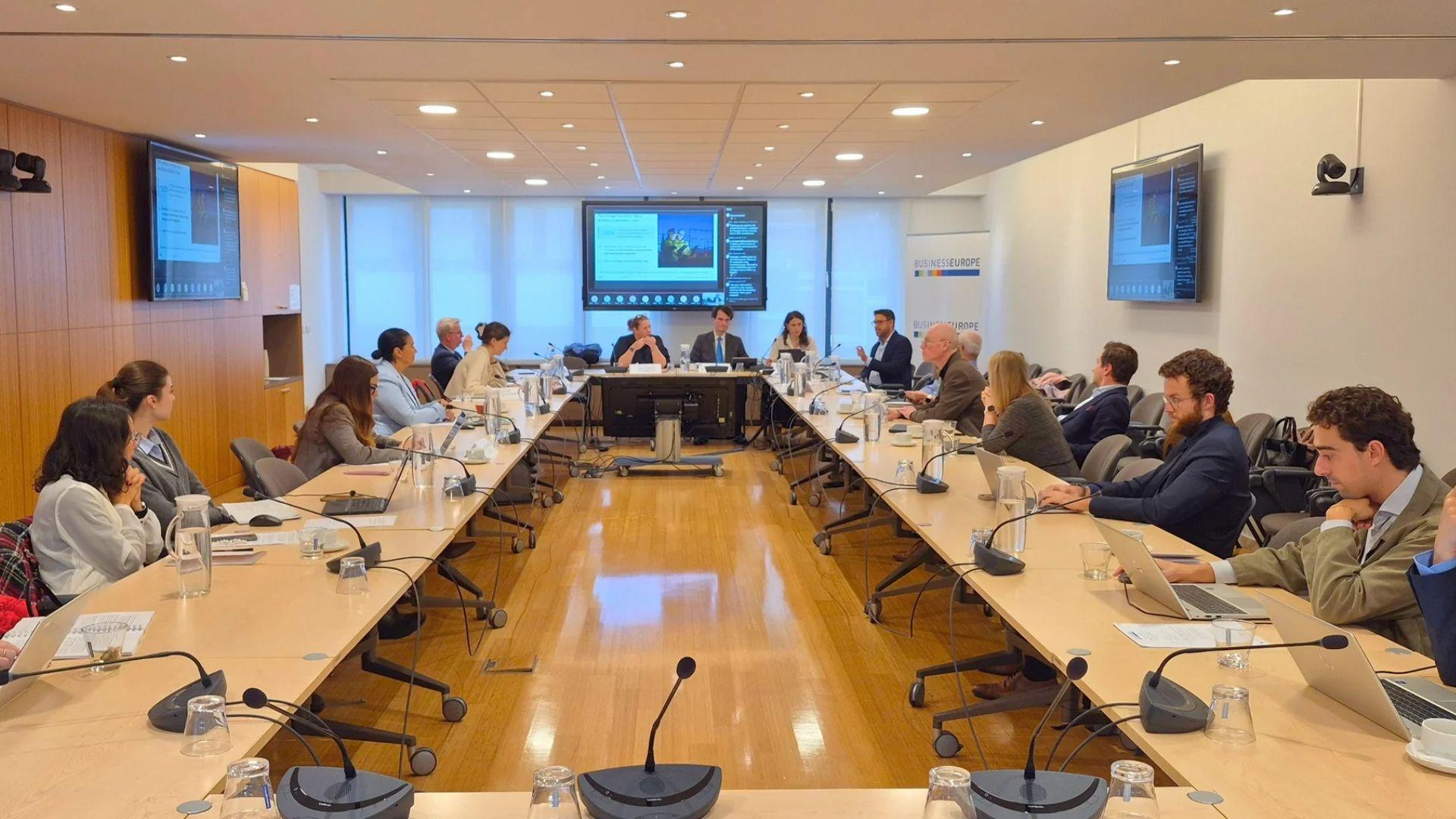
Skills shortages are holding back European companies, especially in fast-changing sectors such as clean energy. The challenge was the focus of a BusinessEurope workshop in Brussels on 23 October 2026, which presented the findings of the ‘Access to Skills’ study.
The study examines employers’ access to skills across sectors in Europe, looking at labour and skills shortages, skills mismatches, training provision and the ability of education and training systems to respond to changing workforce needs. Conducted by Deloitte, the study was commissioned as part of a project carried out by BusinessEurope and involved several EU sectoral organisations, with financial support from the European Union. InnoEnergy Skills Institute took part, bringing a clean energy perspective.
At the workshop, the Director of InnoEnergy Skills Institute, Elias Paul, joined the panel discussion ‘Identified skills needs to practical solutions’, which explored how EU and national policies, education and training systems, and social dialogue can better respond to employers’ needs across Europe.

Expert Contributor
Elias Paul is Director of InnoEnergy Skills Institute, where he leads efforts to equip clean-tech businesses with the skills they need to compete in a fast-moving market.
He has extensive experience working across continental Europe and managing teams in North America and Asia. His background spans general management, finance, operations, commercial, ICT and legal functions at multinational companies.
His experience also spans capital raising, clean-tech innovation and business strategy.
Workforce pressures across clean energy
While the study spans the wider economy, InnoEnergy Skills Institute focused on one of the sectors under most pressure: clean energy. Drawing on the Institute’s experience in clean energy skills development, Elias Paul highlighted the importance of connecting labour market intelligence with practical training solutions.
According to the International Energy Agency (IEA, 2025), 60% of energy organisations report critical hiring bottlenecks linked to labour and skills shortages. With the renewable energy sector reporting structural shortages in technical roles, skilled trades and specialised engineering, the workforce challenge is not a future risk. ‘We don’t have a technology problem, we have a scaling problem’, Elias Paul pointed out during the panel. Expanding solar PV, batteries, wind, hydrogen and heat pumps requires qualified workers to manufacture, install, operate and maintain these technologies. Shortages in these occupations can delay deployment.
These pressures are reflected in workforce projections. The last IEA’s ‘World Energy Employment’ report estimates that around 40% more graduates would need to enter the energy sector globally to prevent skills shortages from worsening by 2030. In Europe, WindEurope (2025) projects that the wind energy sector alone will need more than 160,000 additional workers by 2030.
At the same time, workforce needs differ considerably between technologies, countries and stages of the value chain. The following examples illustrate some of the main pressures across clean energy sectors.
Examples of workforce pressures by sector:
| Sector | Workforce pressures |
| Solar PV | Installation remains central, alongside growing needs in operations and maintenance, grid connection, storage and system integration. |
| Batteries | Demand spans manufacturing, battery management systems, quality assurance, testing, commissioning, safety and grid integration. |
| Wind | Shortages affect technicians, specialised operators, commissioning specialists and engineering roles. |
| Hydrogen | Requirements vary by project, with key roles in process engineering, safety, permitting, commissioning and plant operations. |
| Heat pumps | Bottlenecks include installation, refrigeration, electrical work, system design and servicing. |
Starting from industry demand
One of the study’s central findings is that skills intelligence has advanced across Europe, but the weak link remains turning that evidence into action: needs are identified, sometimes monitored in real time, while curricula and course content lag behind.
This is the kind of gap InnoEnergy Skills Institute works to address. It combines labour market data, industry input, and expert validation to identify emerging workforce needs, the occupations in demand, and the competencies and proficiency levels required for each role. These insights then guide training designed around what workers need to perform effectively on the job. At its core is our Green Skills Framework and Skills Taxonomy, which provides a consistent way to define role-specific skills and map the learning pathways needed to develop them.
That approach is already being put into practice. The workshop was an opportunity to share how it is being applied through initiatives linked to European industrial priorities, including the Net Zero Industry Academies. One example is the European Solar Academy, through which InnoEnergy Skills Institute uses workforce intelligence to develop training that reflects the needs of employers across the solar PV value chain.
Recently, the Academy has launched a series of course collections offering foundational learning in renewable energy and solar PV. While some cover broader topics, others focus on the knowledge and skills relevant to specific job roles. Together, they provide accessible starting points for learners looking to develop their skills in the clean energy sector.
The wider picture: findings from the ‘Access to Skills’ study
While the European Solar Academy offers one example of how industry needs can be translated into training, the study examines the broader challenges facing employers across Europe.
It highlights the need for stronger coordination between existing skills initiatives at European, national and sectoral levels. It also calls for lifelong learning opportunities that better reflect the practical needs and working conditions of employees and businesses.
The findings point to two main challenges for European employers: a shortage of available workers and a gap between the skills people have and those companies need. Addressing both requires closer cooperation between businesses, adult learning providers, and education and training systems. At European level, shared tools, greater transparency and the exchange of good practices can support these efforts while recognising differences between national systems and labour markets. The priority is to ensure that identified skills needs translate into timely, practical and reliable solutions for employers and workers.
The research was developed under BusinessEurope’s ‘Employers Studies’ pilot project to strengthen the evidence available on skills challenges from an employer’s perspective. Its findings are intended to support more informed dialogue between governments, employers and workers’ representatives.
Access the study’s key findings and the full report.