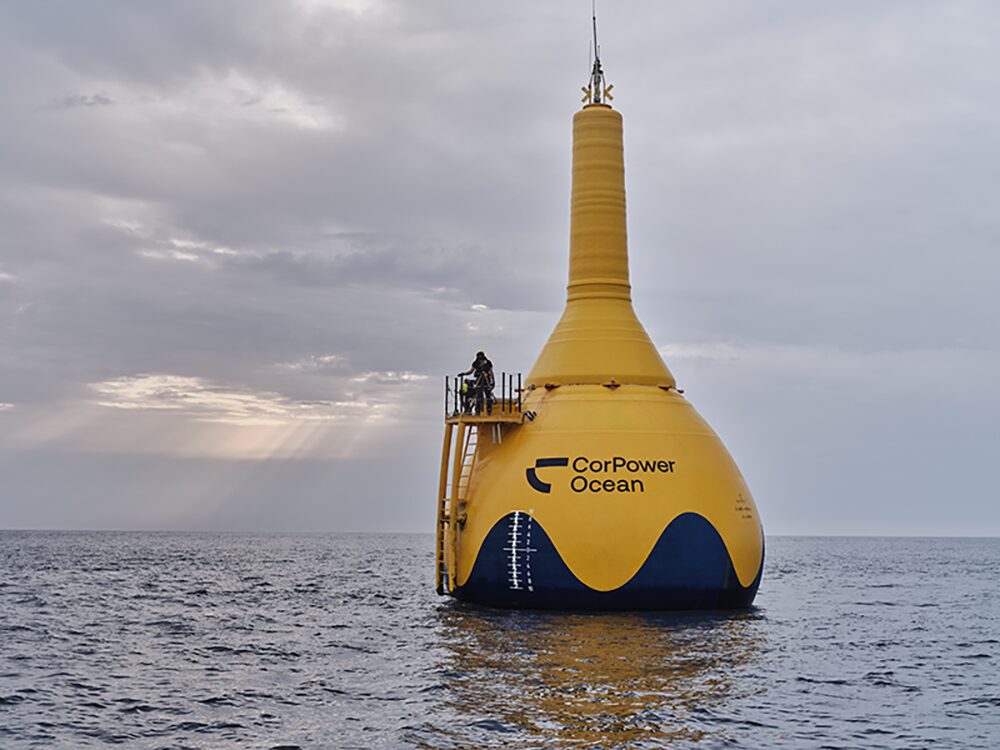
Wave energy has long been described as the missing piece of the clean energy system. The ocean offers vast and consistent power, especially in winter months when electricity demand is highest, yet few technologies have survived the harsh conditions well enough to become commercially viable. Most attempts have fallen to storms, high costs, or engineering limitations. CorPower Ocean is one of the companies rewriting that story.
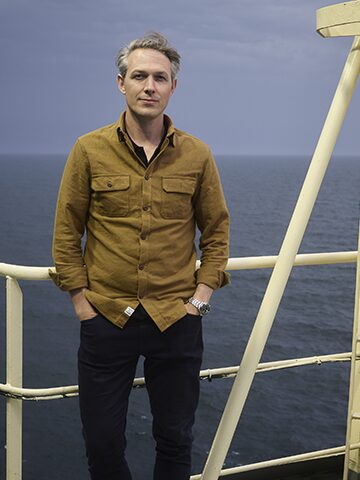
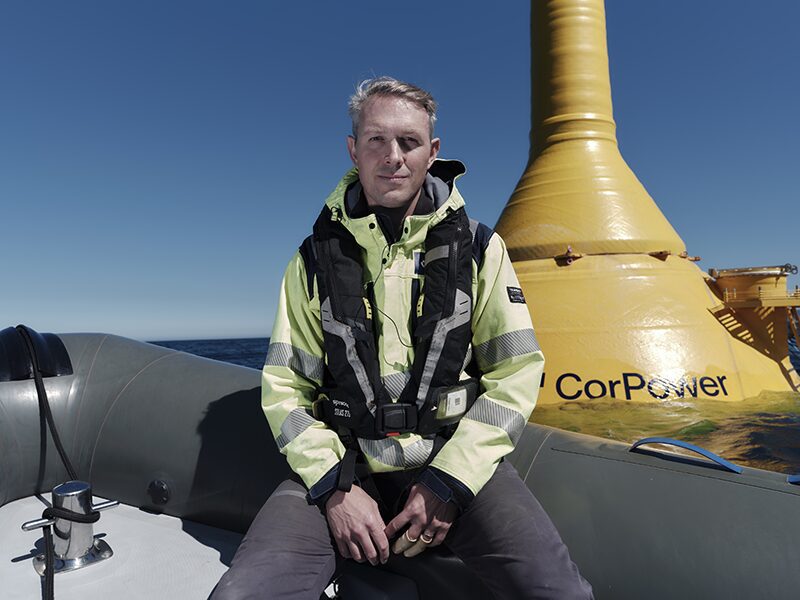
At the centre of that is Patrik Möller, CEO and co-founder of the Swedish company, now recognised internationally for its breakthrough technology.
Curiosity shaped early on
Patrik grew up in an environment that valued understanding how things worked. When asked about his inquisitive mindset, Patrik smiles and recalls how his parents encouraged his curiosity and critical thinking. “They used to say: listen to what others have to say, but always question if it’s right – and whether it can be done better.”
That mindset stayed with him and became a defining trait.
During his master’s year at Berkeley, he became fascinated by semiconductor manufacturing. There, he developed a cost-effective method for forming copper conductors and silicon wafers, which became the basis for his thesis – and his first company.
He ran that semiconductor company for about ten years before the financial crisis forced it to sell its technology. At the time, the next step was uncertain, but it ultimately opened the door to CorPower.
A meeting that changed the path
When Patrik talks about his journey with CorPower, he makes a special point of mentioning that InnoEnergy has been with CorPower from the very beginning – quite literally.
At the time, a patent lawyer friend suggested he meet researchers at the Royal Institute of Technology in Stockholm who were working with a new investor, InnoEnergy, which he said was backing deep-tech inventors and connecting them with entrepreneurs and partners capable of building long-term, industrial-scale businesses.
This is when Patrik met Stig Lundbäck, a cardiologist whose ideas were inspired by the pumping mechanics of the human heart. These ideas would become fundamental to CorPower’s early concept.
“InnoEnergy was there from day one. You could say, my co-founder Stig and I were match-made by InnoEnergy,” Patrik says. “And to this day, their network and continued investment have been central to our success”.
Initially, however, Patrik was skeptical about wave energy. “Most of what you had heard and seen in wave energy had been failures, despite decades of attempts by many smart people.”
To understand the landscape, Patrik and the team went directly to the source. They visited wave energy groups in Trondheim, Lisbon and Edinburgh, studying what had worked, what had not, and why so many efforts had failed.
One insight stood out: devices either failed in storms or became so heavy and costly that the project economics collapsed.
What emerged was the belief that the physics could be used differently. By combining Lundbäck’s ideas with hydrodynamics research from Trondheim and control system work from across Europe, the team began to see a new path forming.
The big leap: Switching between generation and survival
At the heart of CorPower’s technology is phase control.
“The uniqueness of our technology is that we can tune and detune the devices based on ocean conditions.”
In storms, the buoy effectively becomes passive and doesn’t respond to ocean waves. In normal sea conditions, it moves in sync with the waves which strongly amplifies motion and power capture. “This way, each buoy generates about five times more energy than was previously possible.”
Patrik compares it to a familiar mechanism in wind energy: blade pitch control. “In a wind turbine, the blades are turned horizontally when winds are too strong, and adjusted to capture maximum energy under normal conditions.” Until now, this kind of protection and optimisation had been missing in wave energy.
A major step forward came when CorPower integrated inventions from several researchers. Patrik recalls meeting their lead scientist, Jørgen Hals Tudalshaug for the first time, and realising how Stig’s ideas could be combined with his PhD research in wave hydrodynamics from Trondheim. This resulted in the novel “wave spring” principle – a negative spring function combined with a pneumatic pre-tension system that became the foundation of the device’s ability to switch between amplified motion and survival mode.
“Each one of the ideas we got was brilliant, but when combined, it became an amazing system. And when we started testing, we got the big a-ha (moment) that this was actually going to fly.”
Surviving 18.5-metre waves: A turning point for wave energy
Following a structured development programme, CorPower progressed over 12 years from tank tests to ocean prototypes and then to full-scale deployment in Portugal under the HiWave 5 project.
The pivotal moment came in November 2023. Storm Domingos struck their full-scale C4 device with waves reaching 18.5 metres. “We survived every one of them and could go back to tuned operation again immediately after.” Patrik calls it the first time commercial-scale wave energy converters had demonstrated storm resilience at that level.

This achievement strengthened investor confidence and supported CorPower’s 32-million-Euro Series B1 round in 2024, backed by NordicNinja VC, SEB Greentech and InnoEnergy, later joined by Algebris Investments, EIC Fund, GTT and Acario (Tokyo Gas).
Leadership is an ultra-marathon
Patrik describes the journey of leadership as “such an ultra-marathon.” “What we are trying to solve is hard. It’s of similar magnitude to solving fusion or sending people into space.”
Beyond the technical challenge, the real test as a leader has been maintaining motivation through years of complex work. Today, CorPower is in its 15th year.
For him and his team, motivation comes both from progress and purpose. “On the one hand, it’s technical progress that people care about. But above all, it’s the conviction that our technology has a clear place in the market.”
“Wave energy is the missing piece to enable 24/7 clean energy at low cost. And to get to net zero and unlock energy sovereignty in Europe, we really need technologies like this.”
Closing the gap with wind and solar
The next major milestone is reaching financial close on a 45-machine wave farm in Portugal by 2027, part of CorPower’s planned commercial rollout. Over ten years, the goal is “a gigawatt of these devices installed and be cost-competitive with wind and solar.”
A technology that was once considered impossible is now moving towards commercial scale. And Patrik shows no signs of slowing down until he and his team reshape how the world uses its oceans.