
A solar project can have the equipment, financing and installation crew it needs and still lose time waiting for a grid connection. As Europe builds more solar and pairs it with battery storage, workforce planning increasingly means knowing which skills a project will need and when.
That was a running theme at The Business Booster 2026 (TBB), InnoEnergy’s flagship annual event, which brings together start-ups, industry, investors and policymakers from across the clean tech value chain. This year’s edition took place in Munich on 28 and 29 October.
On 28 October, InnoEnergy Skills Institute launched the Clean Tech Skills Report: Trends Shaping 2027-2030 at the InnoEnergy booth, as part of its work within the European Solar Academy. The launch was followed by a discussion with stakeholders from across the solar ecosystem. The European Solar Academy also sponsored Track 4 of the conference programme, and its Track 4B session brought solar and skills into a discussion on European manufacturing, alongside regulation and finance.
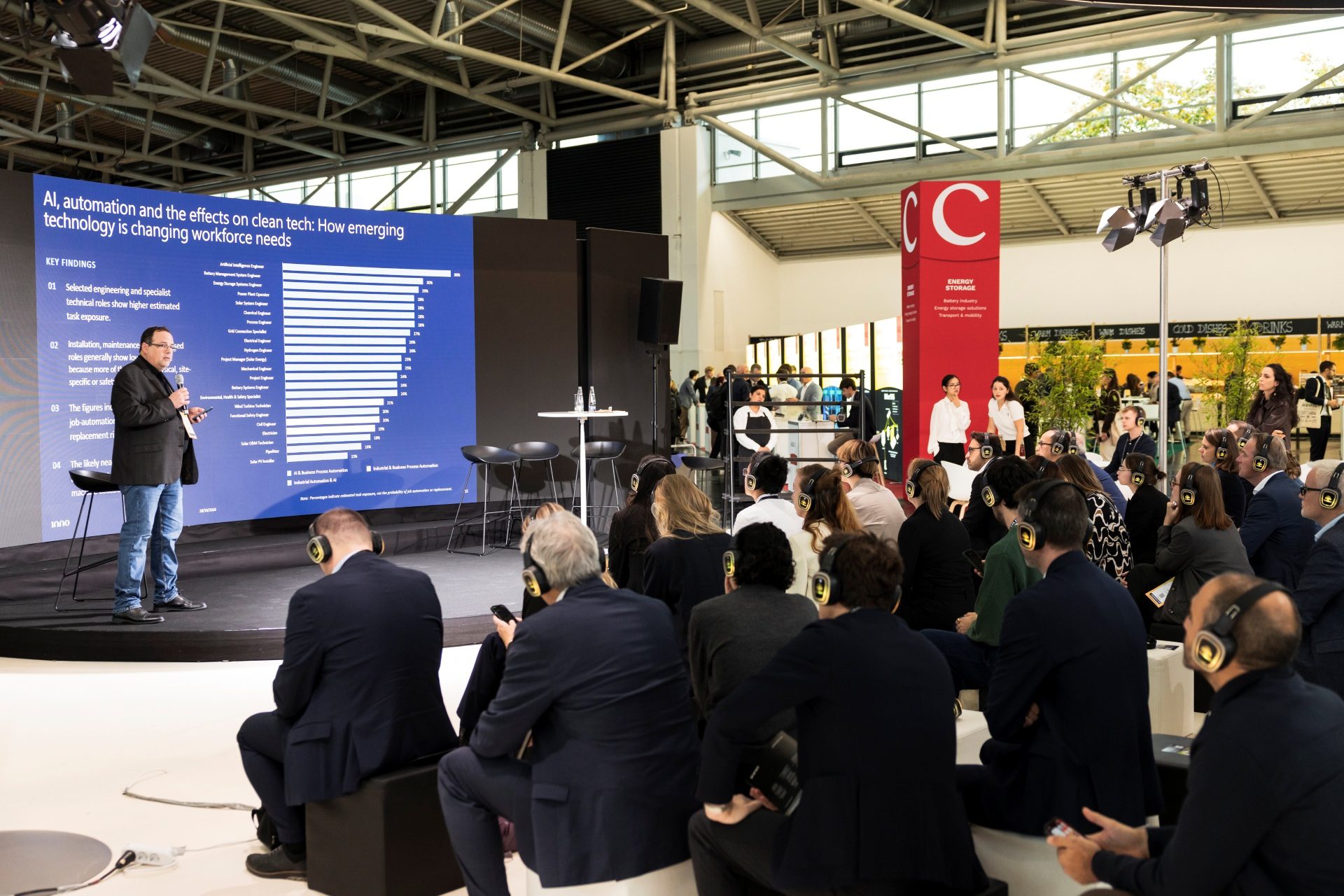
What the Clean Tech Skills Report found
Steven Patterson, Head of Strategy and Partnerships at InnoEnergy Skills Institute, presented the report. It focuses on two priority workforce cases: solar PV, one of the largest and most mature deployment-driven needs, and the fast-growing battery value chain. Solar’s weight is clear from the IEA’s projection that it will account for around 80% of global renewable capacity growth to 2030 (IEA, 2025). Patterson’s starting point was that solar workforce demand is still there and changing shape. He framed the task for training providers as two questions: what to train people for, and how to get them there efficiently.
Hiring is still ahead of skills
According to the report, clean tech hiring continues to outpace skills. Between 2021 and 2025, clean tech hiring grew about twice as fast as the number of workers gaining green skills (LinkedIn, 2025), and the World Economic Forum expects 39% of existing skill sets to be transformed or outdated by 2030 (WEF, 2025). Solar PV jobs fell in 2024, yet the report finds that demand for skilled workers still exceeds what the market can supply.
No single European solar labour market
Conditions vary considerably between countries and along the solar value chain. Installation remains a major source of work, and as Europe’s installed capacity grows, so does the ongoing need for operations and maintenance. Some constraints are also moving elsewhere in the system, towards grid connection, permitting, storage integration and system flexibility. As solar becomes a more mature and interconnected industry, bottlenecks tend to appear in new places, and new roles emerge with them.
High-demand roles and critical roles
The report distinguishes two kinds of shortage. In high-demand roles, such as installers, electricians, technicians and project managers, the challenge is scale. Critical roles in areas such as grid connection, permitting and system design account for far fewer vacancies, but a shortage there can stall an entire project. Planning that counts only vacancies risks missing the small groups of specialists whose absence can constrain delivery.
A broader skills mix
The familiar solar capabilities remain fundamental: PV systems, installation, electrical safety, troubleshooting and maintenance. Around that core, employers increasingly ask for skills in grid integration, storage, data and forecasting. The report is careful about what job-posting data can show. How often a skill appears in postings describes the mix employers are looking for; it does not show whether that skill is scarce. The resulting picture is a transversal one, with shared technical foundations at the core and specialisation layered on top for particular roles.
Solar and storage are converging
Around 15% of new EU battery storage capacity installed in 2025 was paired with solar (SolarPower Europe, 2026). As the two technologies converge, the solar workforce is increasingly hard to plan in isolation. Demand is growing for storage integration, grid services, optimisation, digital energy management and battery operations.
How AI and automation change the work
The report measures how exposed tasks are to AI and automation, which is different from forecasting job losses. Exposure is highest in engineering, analytical and specialist technical activities. Installation and maintenance are less exposed because so much of the work is physical, site-specific and safety-critical. More people are likely to work alongside digital and AI-supported tools in design, monitoring, diagnostics, forecasting and predictive maintenance, and training programmes will need to keep pace.
Transferable skills are a starting point
Convergence and AI were the two forces the presentation returned to most, and both raise the value of transferable skills. Patterson suggested that being able to move between renewable energy sectors now matters more than top-level expertise in a single field. Transferability alone is not enough, though. Electrical skills carry over readily, as do foundations in digital systems, controls, data and predictive maintenance, yet a transferable skill set still falls short of job readiness. An electrician moving into solar-plus-storage already brings much of the electrical foundation and may still need technology-specific knowledge, certification and supervised practical experience. The same principle holds across other clean tech sectors. The practical questions are what a person already knows, where the gap lies, and what the shortest credible route to job readiness looks like.
The report’s conclusion follows from these trends: as demand changes and skills broaden, training needs to become more targeted, modular and responsive.
Clean Tech Skills Report: Trends Shaping 2027-2030
Workforce priorities across solar PV, batteries and other clean tech sectors.
At the booth: reaching the learners employers need
The discussion that followed, moderated by Patterson, brought together Minh Huy Lai, Europe COO of Generation (a global employment nonprofit that trains people and places them into careers), Wolfgang Jooß, Chief Technology Officer of RCT Solutions (a renewable energy technology company that sets up integrated PV manufacturing facilities), and Elias Paul, Director at InnoEnergy Skills Institute. The speakers broadly agreed that workforce challenges vary across the solar value chain and are shaped by several connected factors.

Lai said it has become much harder to reach the people who need upskilling. Employers need skilled people, while training providers struggle to reach and mobilise potential learners.
Jooß brought the manufacturing perspective. He noted that upstream solar manufacturing jobs in Europe have been declining, with most production now taking place outside Europe. With research funding also under pressure, Europe risks losing process-engineering knowledge, even as modern factories need fewer staff than in the past. Keeping that expertise available calls for a different training response from the one needed to bring more people into installation.
Paul focused on how training can help. InnoEnergy Skills Institute aims to contribute to a reliable European talent pool, he said, through modular training that helps people build on what they already know and prepares them ahead of demand. Projects such as the European Solar Academy also aim to contribute to this within specific sectors, in this case solar PV.
Skills as part of industrial strategy
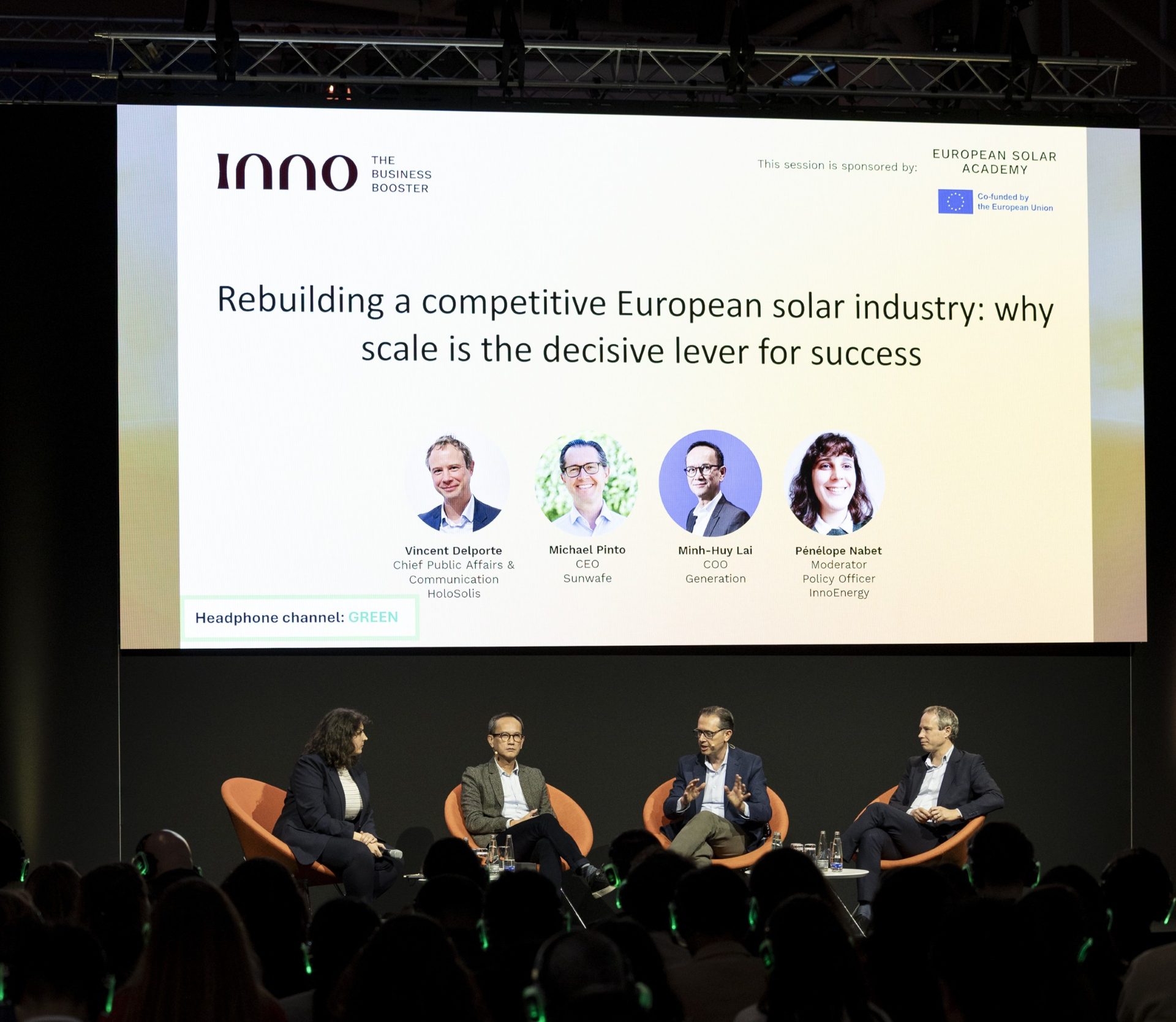
The Track 4B session, moderated by Pénélope Nabet, Senior EU Affairs Manager at InnoEnergy, looked at what it will take to manufacture solar at scale in Europe. Vincent Delporte, Head of Public Affairs at HoloSolis (a French manufacturer of low-carbon PV cells and modules, building a gigafactory in Hambach), said clear regulation and production at scale are important for European manufacturing, and that finding and training people is central to any factory ramp-up.
Michael Pinto, CEO of Sunwafe (which is developing a large-scale silicon ingot and wafer plant in Asturias, Spain), linked investment to policy clarity. In his view, risk capital becomes more available when the rules of engagement are understood. He pointed to public procurement as one way to create demand, and to the EU’s proposed Industrial Accelerator Act as an attempt to provide that clarity. He also suggested that companies often fail through a lack of communication and trust, a point he tied to the human dimension of industrial projects.
Lai described how Generation builds its programmes. Rather than assume what industry needs, the team asks employers, and the conversation tends to turn quickly to mindset and interpersonal skills alongside technical ones: the combination that helps people get a job and then stay and progress in it. Training providers cannot design these programmes alone, he said, and need employers and public authorities involved. On funding, he described skills development as an ecosystem effort. Employers have their part to play, through funding as well as curriculum input and internships, and so do learners, by taking ownership of their own development. Philanthropy can help test new delivery models, while public funding can help programmes scale. His advice to employers was to start training now for the skills they will need in two to three years.
What this means for employers
The business case for training starts with a specific delivery risk. Which roles could delay commissioning or slow a production ramp-up? How long will it take to develop those skills, and which existing staff could get there fastest? Tracking time to competence and the delays tied to hard-to-fill roles can help employers estimate that risk and decide where training investment is most valuable.
Download the Clean Tech Skills Report: Trends Shaping 2027-2030 to explore workforce priorities across solar PV, batteries and other clean tech sectors through 2030.
Download the report →For a closer look at solar, join the free webinar, Europe’s solar workforce towards 2030, with SolarPower Europe on 10 December, 14:30-15:30 CET.
Register for free →- European Commission. (2026, March 4). Proposal for a regulation on establishing a framework of measures for accelerating industrial capacity and decarbonisation in strategic sectors (Industrial Accelerator Act) (COM(2026) 100). https://single-market-economy.ec.europa.eu/publications/industrial-accelerator-act_en
- InnoEnergy Skills Institute. (2026). Clean tech skills report: Trends shaping 2027–2030. https://innoenergy.com/news-resources/clean-tech-skills-report-trends-shaping-2030/
- International Energy Agency. (2025). Renewables 2025. https://www.iea.org/reports/renewables-2025
- LinkedIn Economic Graph. (2025). Global green skills report 2025. https://economicgraph.linkedin.com/content/dam/me/economicgraph/en-us/PDF/2180-global-green-skills-report-v04.pdf
- SolarPower Europe. (2026). European battery market outlook 2026–2030. https://www.solarpowereurope.org/insights/outlooks/european-battery-market-outlook-2026-2030-1
- World Economic Forum. (2025). The future of jobs report 2025. https://www.weforum.org/publications/the-future-of-jobs-report-2025/