The clean tech skills gap is now also a delivery and cost problem, not just an HR one: limited workforce capability is becoming a major constraint alongside challenges related to capital, technology, infrastructure, and regulation. Nearly 60% of energy companies report labour and skills shortages, and the supply pipeline is not keeping pace: demand for applied technical workers rose about 16% between 2015 and 2022 while vocational graduates rose only 9% (IEA, 2025). Connecting roles, skills, training and certification into one system builds readiness, so that learning becomes operational capability.

Expert Contributor
Dimitra Maleka is Skills Intelligence Manager at InnoEnergy Skills Institute, where she leads skills intelligence to support workforce development across Europe’s clean-tech industries. With 7+ years across EU workforce initiatives and a background in engineering, she helps align skills frameworks and learning programmes with Europe’s energy transition goals.
Close to 40% of core job skills are expected to change by 2030 (World Economic Forum, 2025). For clean tech, the pressure is sharper: Europe’s energy sector is projected to need around 3.5 million additional workers by 2030 (JPMorganChase, 2026).
The roadmaps are set, and capital is flowing: clean tech is projected to attract around €5 trillion in annual investment by 2035, yet human capital is proving much harder to scale (Bou, 2026). What sets the pace now is people. Workforce capability is becoming an increasingly important factor in how quickly projects can be delivered, alongside financing, technology, infrastructure, and regulation. For clean tech organisations, the skills gap has become a delivery risk with a cost attached, not only an HR line item.
Where does the clean tech skills gap show up
It shows up first in delivery: delayed projects and slower deployment, not only unfilled vacancies. Nearly 60% of energy companies now report labour and skills shortages (IEA, 2025). The shortage is sharpest in applied technical roles: electricians, installers, technicians, plant operators. These are the people who put clean tech in the ground and keep it running.
The trajectory is uneven even where jobs are growing. EU solar employment was projected to ease by about 5% in 2025 as residential installs slow (SolarPower Europe, 2025), before growth returns, though how fast recovery comes is expected to vary by market. Wind is projected to reach 607,000 jobs in Europe by 2030 (WindEurope, 2025). Demand is rising while the specialist workforce falls behind it.
The skills pressure by technology sector
The same pattern recurs across the main clean tech sectors. The work is there; the pressure sits in specific, role-level skills. The examples below are illustrative, not exhaustive.
| Sector | What’s happening | Where the skills pressure sits |
| Solar | Employment was projected to ease by around 5% in 2025 following a record high, with recovery expected from 2026, although the outlook remains sensitive to uneven market development. Most jobs are in deployment (~85%); manufacturing is most exposed to competition from outside the EU; O&M is rising in geographies where the installed base is growing. As utility-scale projects gain importance, workforce demand is becoming more dependent on the type and location of new development. | Installers, electricians, site managers and O&M technicians (digital monitoring, system integration), plus manufacturing engineering, R&D and regulatory capability. Grid integration and permitting roles are also essential as grid integration becomes a greater deployment bottleneck. Deployment, O&M, and manufacturing each need a distinct pathway. |
| Wind | Europe’s wind workforce is projected to reach 607,000 by 2030, an estimated increase of a bit more than 35% compared to 2025. Manufacturing is a major hiring hub, accounting for nearly half of direct employment in Europe. Demand is also linked to the growing installed base, with technicians and service roles needed across O&M. | Blade technicians and welders in manufacturing are major hiring needs, alongside growing demand for wind turbine technicians as installed capacity expands. Upskilling needs centre on blade repair, control systems, digital monitoring and working at heights. Potential transition pools include workers from oil and gas, maritime, construction and electrical trades, subject to targeted wind-specific training and certification. |
| Heat pumps | Installers are the critical messengers for heat pumps over boilers. Experienced gas engineers can move to competent heat pump engineer roles with targeted training, but practical readiness remains a challenge after training. Experienced gas and oil heating installers already hold many relevant foundation skills and can also move into this area with specific upskilling. | A practical gap, not only a theoretical one. Electricians and heat engineers need different, role-specific pathways, and training must convert to practice, not just completion. Pressure also affects system designers and service technicians, with installation quality directly influencing performance. |
Sources: SolarPower Europe (2025), WindEurope (2025), and Clean Heat: Jobs and skills for the future – Energy UK.
Two themes cut across all of these sectors: digitalisation and AI.
- Digital capability is becoming embedded across most energy roles rather than held by one team, spanning cybersecurity, data governance, and ESG reporting through real-time operational tooling and troubleshooting complex automated systems.
- AI talent concentration in energy is about 40% lower than in financial services and technology (IEA, 2025), even as demand clusters around practical uses such as operational efficiency and maintenance and repair. A base level of AI literacy, tied to real operational use cases, is becoming a general expectation across a growing range of roles rather than remaining limited to specialist ones.
Why hiring alone does not close the gap
Hiring more people does not, on its own, produce readiness. You can fill a role and still miss a delivery date if the person is not ready to operate the new system. Roles are changing faster than training adapts, so the challenge is often framed as an accountability gap rather than a simple headcount shortage.
The supply side confirms it. Demand for applied technical workers rose about 16% between 2015 and 2022 while vocational graduates rose only 9% (IEA, 2025). The problem is not only the number of potential workers, but whether education and training pipelines produce enough people with the skills, qualifications, and practical readiness employers require.
What does closing the gap actually take
Closing the gap requires better alignment and sequencing of investment, along with sufficient training capacity, infrastructure, and qualified instructors. The IEA estimates that new entrants into the energy sector must rise by around 40% by 2030 simply to prevent shortages from widening further (IEA, 2025). This highlights the scale of the workforce response required, as well as the potential costs of stalled deployment.
The scale of the shift
- Nearly 60% of energy companies report labour and skills shortages (IEA, 2025)
- Demand for applied technical workers rose about 16% (2015–2022) while vocational graduates rose only 9% (IEA, 2025)
- Europe’s energy sector is projected to need around 3.5 million additional workers by 2030 (JPMorganChase, 2026)
- New entrants must rise about 40% by 2030 simply to prevent shortages from widening (IEA, 2025)
- Around 40% of core job skills are expected to change by 2030 (WEF, 2025)
What closing the gap requires
- Better skills and job intelligence, so organisations can see which skills each role actually requires.
- Investment in projects, training capacity, facilities and instructors, sequenced so learning leads to employment.
- Easier worker mobility across regions and adjacent sectors.
- EU-level coordination to scale what works and avoid duplication.
The direction of travel is clear: around four in five employers now treat reskilling and upskilling as critical to business strategy (World Economic Forum, 2025).
How to build workforce readiness
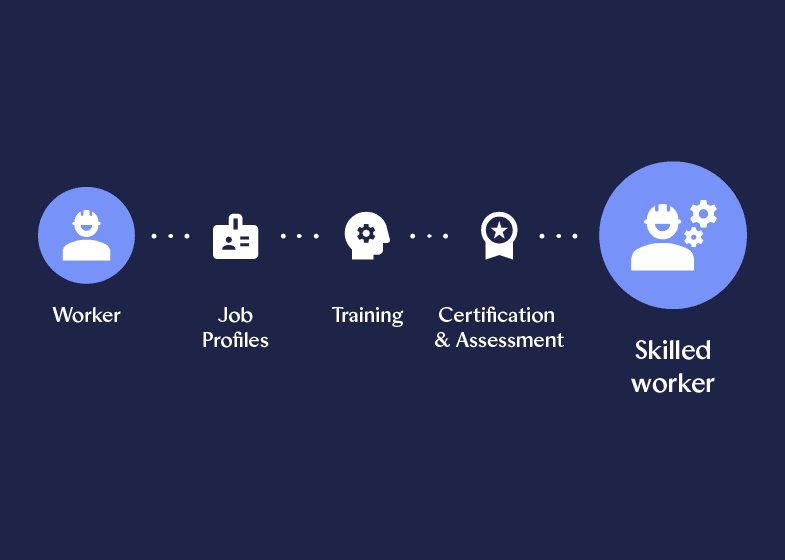
Workforce readiness is built, not hired. It comes from connecting roles, skills, training and certification into one system, so that learning shows up as operational capability rather than course completion:
- Get clarity on what each role needs and identify the specific skills the role needs.
- Upskill your people with purpose with flexible training programmes, built to match your team’s needs.
- Know they are job-ready: validate skills through industry-recognised certifications and assessments, ensuring your workforce meets the latest clean tech standards.
This approach forms part of the Green Talent Accelerator framework developed by InnoEnergy Skills Institute. It connects role-specific skills, curated training, and industry-recognised certifications into a structured system for solar workforce development.
Where to start
Where you start depends on where the gap sits. The guide below covers the workforce challenges common to clean tech and energy transition organisations, with practical ways to respond. Download the guide.
- Bou, E. (2026, July 22). The missing infrastructure: why clean tech cannot scale without skills. Forbes.
- Council of the European Union. (2026, February 24). Council signs off simplification of sustainability reporting and due diligence requirements to boost EU competitiveness [Press release].
- Energy UK. (2026). Clean Heat: Jobs and skills for the future.
- European Financial Reporting Advisory Group. (2025). State of play 2025: Implementation of the European Sustainability Reporting Standards.
- International Energy Agency. (2025). World Energy Employment 2025.
- JPMorganChase. (2026, April 29). JPMorganChase supports skills training in Europe’s energy sector [Press release].
- SolarPower Europe. (2025). EU solar jobs report 2025.
- WindEurope. (2025). Europe’s wind energy workforce report.
- World Economic Forum. (2025). The future of jobs report 2025.